Insight Digest | Issue #9
In Insight Digest, we showcase the latest happenings in science research.From Instability to Saturation: Tracking the Thermodynamic Life Cycle of Tropical Mesoscale Convective Systems
Kafy, A.A., Ibrahim, W.M., Baky, A.A. et al. Sci Rep 16, 6827 (2026) (IIT BOMBAY) Subjects: Mesoscale Systems, Lagrangian Framework, Precipitation Mesoscale convective systems (MCSs)—large, organized clusters of thunderstorms that can span hundreds of kilometers and persist for many hours—generate roughly half of all tropical rainfall. Despite their outsized climatic importance, MCSs are poorly represented in global climate models and are often misrepresented even in convection-permitting simulations. A major reason is that we lack clear observational benchmarks for how the thermodynamic environment surrounding an MCS evolves as the system moves through its life cycle, from birth to decay.
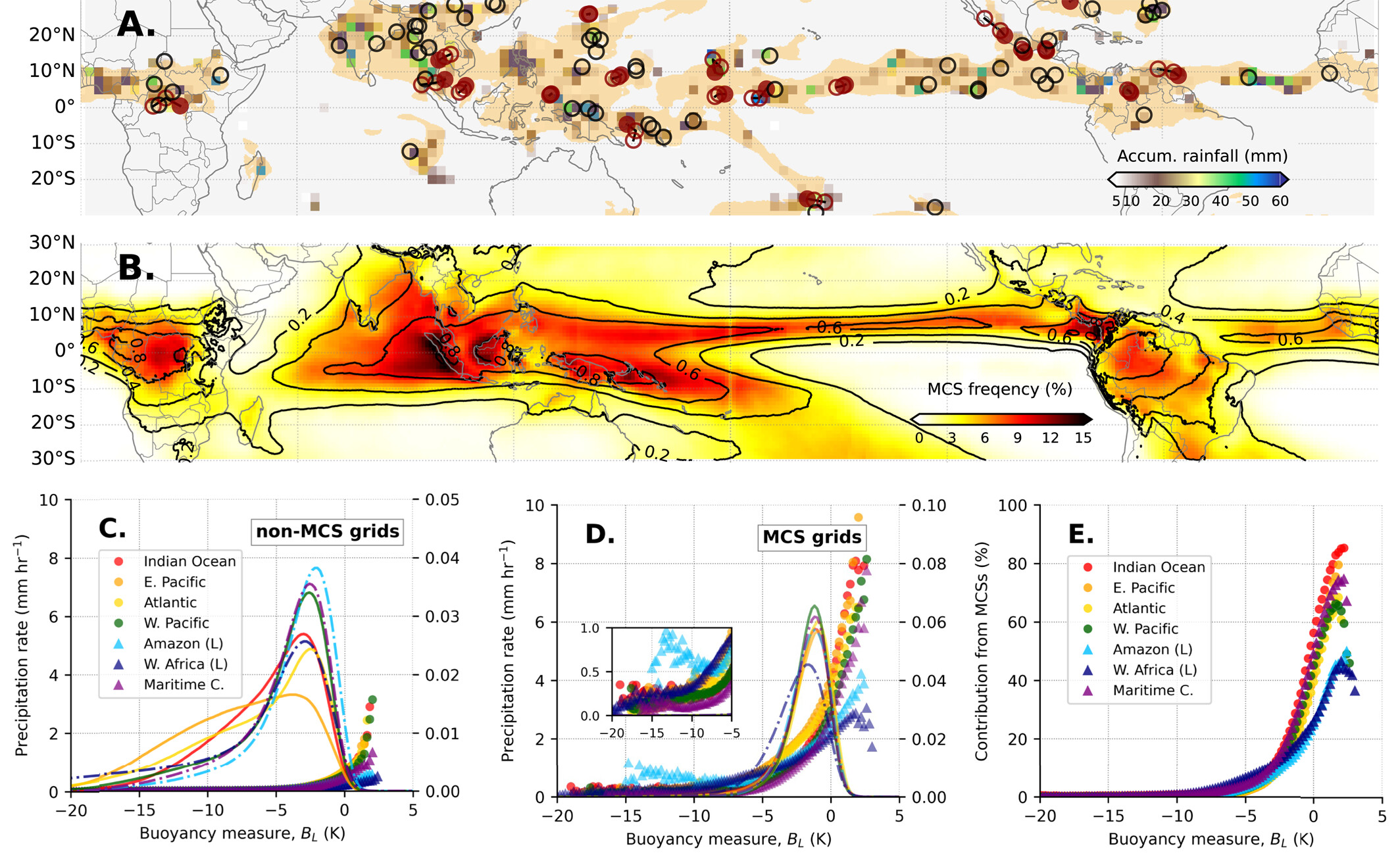
This study addresses that gap by combining two datasets: a 20-year, satellite-derived global MCS tracking database (PyFLEXTRKR, using GPM IMERG precipitation and infrared brightness temperature) and hourly ERA5 reanalysis fields. Nearly 100,000 tropical MCS tracks (56,605 oceanic, 42,549 continental) were analyzed. The key diagnostic tool is an empirical lower-tropospheric buoyancy measure, B_L, previously developed to link convective instability to precipitation in an Eulerian (fixed-location) framework. Here it's applied for the first time in a Lagrangian sense—following individual MCSs through time.
The central finding is that MCS frequency and precipitation intensity are tightly linked to periods when B_L exceeds roughly −5 K, a threshold that also marks where non-MCS convection begins to substantially deepen—suggesting this value marks a general transition into deep, organized convection. More importantly, the two B_L components trace distinct, physically interpretable trajectories across the life cycle. Initiation is characterized by high undilute instability combined with moderate subsaturation—conditions favorable for triggering but not yet fully moistened. As MCSs mature, instability actually decreases, but the environment becomes nearly saturated, sustaining strong precipitation through a different mechanism—one likely tied to boundary-layer cooling from evaporating stratiform rain rather than fresh convective instability. By the decay and termination stages, the environment becomes both stable and strongly subsaturated, effectively shutting down further convective development.
This life-cycle-dependent decoupling between instability and moisture has an important implication: B_L alone, without knowing the life-cycle stage, is not a fully sufficient predictor of MCS behavior—precipitation and buoyancy relationships depend on convective memory (the recent history of the system), not just the instantaneous environment. The associated vertical velocity fields (from ERA5) and cold-cloud fractions support this interpretation, showing consistent low-level ascent that weakens as systems decay.
Dynamics of Superconducting Pairs in the Two-Dimensional Hubbard Model
G. Sordi, E. M. O’Callaghan, C. Walsh, M. Charlebois, P. Sémon, and A.-M. S. Tremblay. Phys. Rev. Lett. 136, 256503. June 2026 (DPS, IISER Kolkata) Subjects: Twisted bilayer graphene, superconductivity, strong-correlations This work investigates the specific time and energy scales that allow electrons to form superconducting pairs within the two-dimensional Hubbard model. Specifically, it seeks to identify which processes acting at which energy scales play the role of the "glue" that binds electrons together to bring about superconductivity.
For several decades, the mystery of high-temperature superconductivity – the ability of certain normally insulating materials to conduct electricity without any energy loss at relatively higher temperatures – has remained one of the most significant challenges in modern physics. It is accepted that superconductivity requires electrons to form tightly bound states called _Cooper pairs_; **however, it is not clear how materials with strong Coulomb repulsion between electrons, such as the high-T_c cuprates that show high temperature superconductivity, will lead to such attractive pairs**. In particular, we still lack a fundamental understanding of the electron dynamics, or the "timing" of their interactions that form the _pairing mechanism_.
In the past, theoretical approaches have struggled to reconcile the different and often conflicting timescales at play: some interactions happen nearly instantaneously, while others occur much more slowly. **This is particularly challenging because multiple energy scales and timescales have to be treated on an equal footing, meaning methods that make adhoc assumptions and approximations will not work**. This work studies these questions on the 2D Hubbard model – a model of electrons that can move around on a lattice as well as feel the Columb repulsion of other electrons if they happen to appear on the same site.
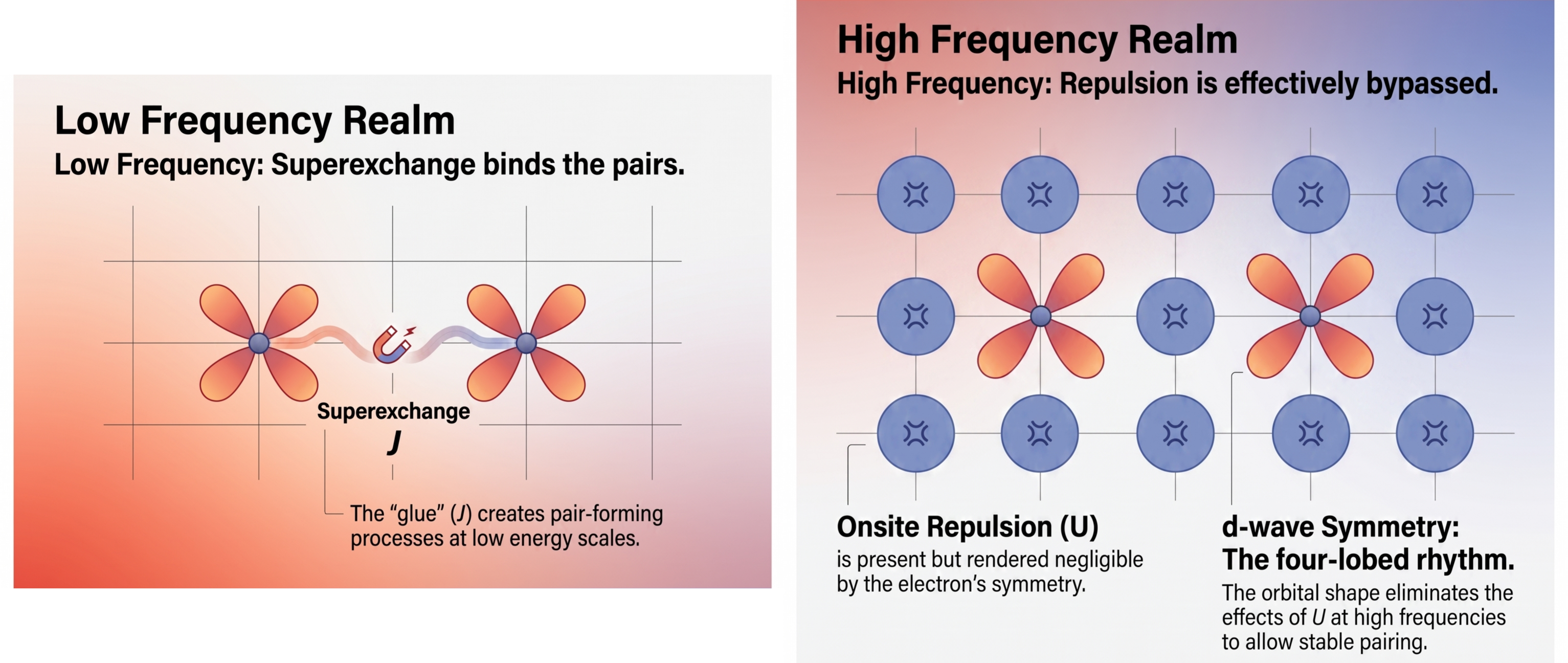
**The work reveals that superconducting pairing is almost entirely a low-frequency, long-lived process driven by "superexchange" interactions**. This is an effective tendency that is mediated by the electronic Columb repulsion in the presence of the kinetic energy. Because the repulsion favours each site to have a single electron, two nearest-neighbour sites must have opposite spins, otherwise an electron cannot move from one site to the other (owing to Pauli's exclusion principle). This leads to an emergent effect where a pair of adjacent sites lower their energy by making the electrons spin antiparallel, and it is this binding effect that leads to the pairing.
**The work also found that high-frequency electronic repulsion—which usually breaks pairs—is effectively bypassed by the _d_-wave symmetry of the electrons**. The _d_-wave symmetry refers to the fact that the 2D square lattice structure causes the two electron wavefunction to vanish when they occupy the same site. Ultimately, therefore, the net contribution to superconductivity comes solely from the previously mentioned slower processes, confirming that the "glue" of the system operates on a very specific, manageable timescale.
Can our brain predict our next friend?
Shen, Y.L., Hyon, R., Wheatley, T. et al. Neural similarity predicts whether strangers become friends. Nat Hum Behav 9, 2285–2298 (2025) (Research Scholar, DBS, IISER Kolkata) Subjects: fMRI, Neural homophily, social neuroscience, Default Mode Network, Frontoparietal Control NetworkEver pondered: why do we instantly vibe with some people while others remain strangers?
Well! A new study published in Nature Human Behaviour shows that a part of the answer lies in ‘how our brain processes the world!’ This new longitudinal study claims that our brain might predict ‘who will be your next friend’ even without meeting them.
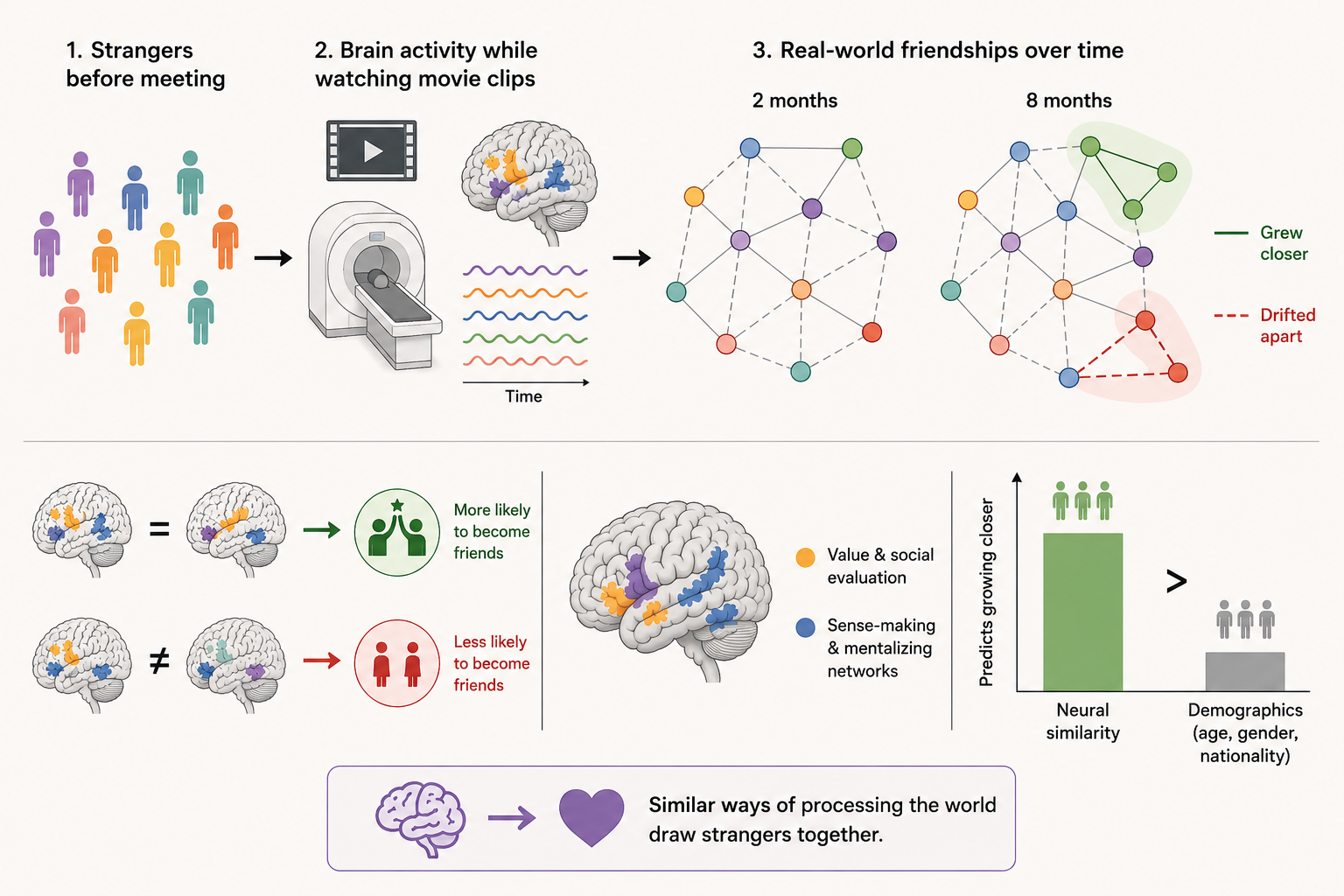
Researchers carried out fMRI on 41 incoming graduate students on their arrival in the campus even before they had a chance to interact or meet each other. While undergoing fMRI, participants were shown a series of short movie clips of different genres (like documentary, comedy, debate ) spanning different topics (such as food, science, sports, environment and social events). The results seem quite interesting: pairs of participants whose brains had responded to the videos in similar ways as total strangers were significantly more likely to become close friends over time (8 months were considered as the span) or in the other way the neural patterns were especially strong among pairs of participants who grew closer during the study. This wasn’t just about liking the same show/ movie clip, the effect held up after accounting for shared demographics like age, nationality, and gender. Researchers show that the participants who became friends in the eight-month mark showed higher initial similarity in the left orbitofrontal cortex of our brain,also neural similarity across 40 different brain regions predicted which pairs of participants would grow closer over time. The regions included the Default Mode Network (DMN) and Frontoparietal Control Network (FPCN), which are involved in "sense-making," mentalizing, and interpreting complex social narratives.
This study concludes by saying that while friendships may begin by chance, long-term compatibility is shaped by pre-existing similarities in how people perceive, interpret and respond to the world. Finally the study introduces the term- neural homophily, suggesting that we are naturally captivated by those who "see the world" the same way we do.