
Quantum at 100: From Heisenberg’s Revolution to Modern Science
Reviewed by Archita Sarkar, Dishari Dasgupta
What we observe is not nature itself, but nature exposed to our method of questioning. — Werner Heisenberg
The Birth of New Science (1925)
At the beginning of the 20th century, classical physics, comprising Newtonian mechanics and Maxwell’s electrodynamics, was regarded as a nearly complete theoretical framework. The two pillars of physics seemed complete until experimental observations at microscopic scales revealed their limitations.
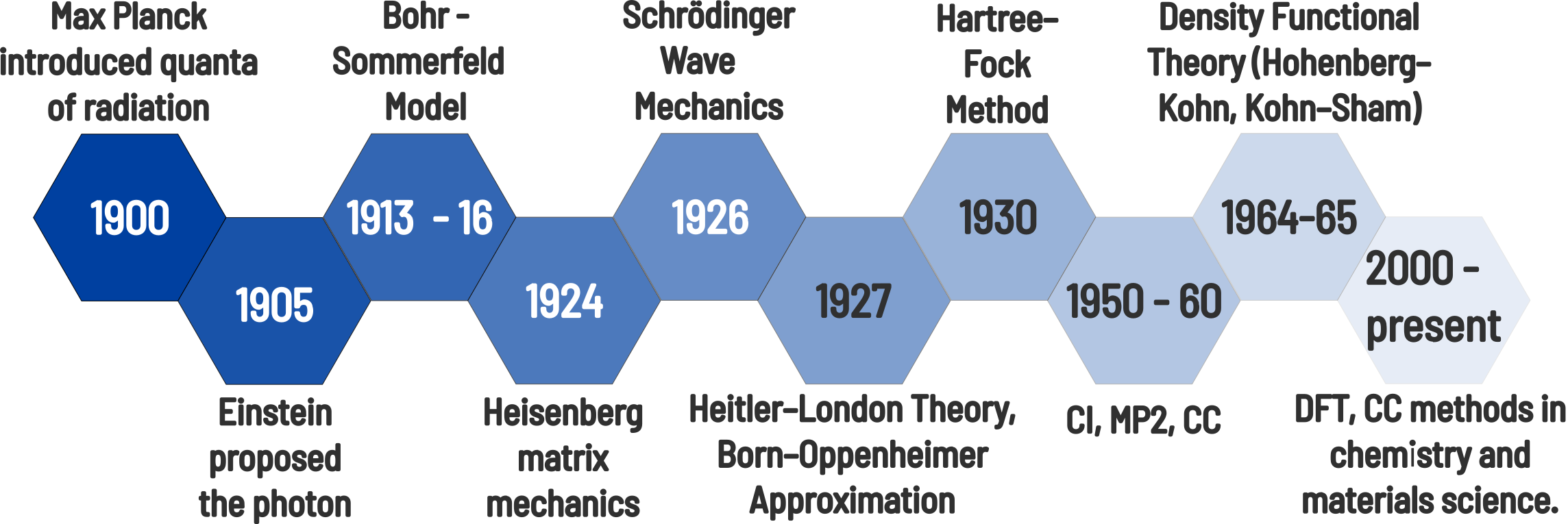
One of the earliest inconsistencies arose with the failure of blackbody radiation. According to the classical theory, Rayleigh–Jeans law, the emitted energy would diverge at high frequencies, becoming infinitely large, resulting in the ultraviolet catastrophe [1]. To overcome this problem, Max Planck proposed in 1900 that electromagnetic radiation is exchanged in discrete energy packets, or quanta, with energy [2]
Shortly thereafter, Albert Einstein extended this concept to light, explaining the photoelectric effect by introducing light quanta (photons), thereby establishing the particle nature of electromagnetic radiation [3].
Despite these successes, the structure of the atom remained partially understood. The Bohr–Sommerfeld model (1913–1916) introduced a semi-classical picture in which electrons occupy discrete orbits around the nucleus [4] and transition between them via quantised angular-momentum conditions,
[5] . While this model successfully explained the hydrogen spectrum, it could not accurately describe fine spectral properties like anomalous Zeeman effect [6], Stark splitting [7], or transition intensities, indicating the absence of a theoretical foundation.
A major turning point occurred in 1925, when Werner Heisenberg rejected the classical idea that electrons move along well-defined trajectories around the nucleus. Instead, he argued that the atomic theory should be constructed entirely from quantities that can be experimentally observed. In his correspondence with Wolfgang Pauli, Heisenberg criticised the orbital picture of electrons and proposed that atomic behaviour should be described using measurable spectroscopic quantities such as transition frequencies and spectral intensities. Expressing his discontent with classical orbitals, Heisenberg explicitly stated:
All of my pitiful efforts are directed at completely killing off the concept of orbits, which, after all, cannot be observed, and replacing it with something more suitable.
In this new approach, physical quantities were represented through a transition between quantum states rather than through a definite electron path. The central aspect of the new formalism was that the ordering of operators is essential, such that [8-9]. The formalism was later extended into matrix multiplication by Max Born and Pascual Jordan, who represented physical observables as matrices acting on quantum states. This new theory successfully explained atomic spectra, including discrete energy levels and transition rules.
Although quantum mechanics initially emerged to explain atomic phenomena, it soon developed into a broader framework for understanding systems across multiple length scales, ranging from electrons to molecules to material and biological systems.
From Orbits to Bonds: Birth of Quantum Chemistry (1927)
With quantum mechanics, chemists had a new question: how do atoms combine and form stable molecules?
Before the 1920s, the bonding was described through empirical valence rules and structural observations, without a rigorous microscopic explanation. There was no microscopic explanation for why two hydrogen atoms form a stable molecule. In 1927, Walter Heitler and Fritz London presented their study on H2 [12] using the wave mechanics introduced by Erwin Schrödinger. The electronic behaviour of the molecules is governed by the time-independent Schrödinger equation
where is the Hamiltonian operator, is a two-electron wavefunction, and is the corresponding energy eigenvalue. For the hydrogen molecule, the full molecular Hamiltonian in atomic units () takes the form:
where and are the Laplacian operators representing the kinetic energy of electrons 1 and 2, respectively, , , and denote the distances of each electron from nuclei A and B, is the interelectronic distance, and is the internuclear separation. The first two terms are kinetic energy, the next four terms are electron-nuclear attraction, and the last two terms are electron-electron and nuclear-nuclear repulsion,
As atoms come close together, their electronic wave functions interact and mix. Because electrons are indistinguishable fermions, the total electronic wavefunction must satisfy the antisymmetric condition imposed by the Pauli exclusion Principle. This produces two distinct arrangements:
-
Bonding state (symmetric spatial part, spin singlet): the overlap of electronic wavefunctions increases electron density in the region between the nuclei. This lowers the total energy and stabilises the molecule.
-
Antibonding state (antisymmetric spatial part, spin triplet): the overlap generates a nodal region between the nuclei, decreasing electron density in the internuclear region. As a result, the energy increases and the molecular configuration become unstable.
The energy lowering in the bonding state comes from the quantum mechanical exchange effect, a direct consequence of anti-symmetrisation of the wavefunction. This was the first quantum mechanical explanation of the covalent bond, and it became the basis of Valence Bond Theory, making the shift from qualitative valence rules to quantitative solutions of the Schrödinger equation.
Solving the Molecular Problem: The Born–Oppenheimer Approximation (1927)
Understanding bonding in principle was one part. Solving the Schrödinger equation for real molecules, with all electrons and all nuclei interacting simultaneously, remained a serious challenge. Born and Oppenheimer introduced a powerful simplification based on physical observation. The nuclei are approximately times heavier than electrons. This means electrons respond almost instantaneously to any nuclear motion, while nuclei move on a much smaller timescale. The two motions are nearly decoupled.
This approximation enables the total molecular wavefunction to be separated into two simpler parts: one associated with electronic motion and the other describing the nuclear motion.
-
Electronic part: Solve for electrons in a fixed nuclear framework to obtain .
-
Nuclear part: Use as an effective potential governing nuclear motion.
This separation is the foundation on which quantum chemistry is built. It converts an intractable coupled problem to a manageable sequence of calculations.
The Hartree–Fock Method and the “Mean-Field” Approximation
Even after fixing the nuclear positions within the Born-Oppenheimer approximation, the resulting electronic problem remains highly nontrivial. The motion of one electron is inherently coupled to that of all others through Coulombic interactions, making the many-electron Schrödinger equation intractable. To render the problem, approximate methods must be employed, of which Hartree-Fock (HF) is among the most foundational. The HF method was developed by Hartree in 1927-1928 and rigorously reformulated by Fock and Slater in 1930 [14-15].
The central idea of the theory is based on a simple assumption that, instead of explicitly treating the instantaneous interaction of every electron with all other electrons, each electron is expected to move independently within a mean field generated by the remaining electrons. Under this approximation, the many-electron Schrödinger equation is transformed into a set of coupled single-electron equations that can be solved self-consistently.
In the HF framework, the N-electron wavefunction is expressed as a Slater determinant[16], a determinant of a matrix of single-electron orbitals. This construction automatically satisfies the antisymmetry property, i.e. swapping any two rows of a determinant flips its sign. This enforces the Pauli exclusion principle.
The resulting HF equations are then solved using an iterative method in which an initial guess for the electronic density is made, from which an effective potential is constructed. Then the resulting equations are solved for new orbitals, and this procedure is repeated until self-consistency is reached.
HF treats electron-electron repulsion on average. But the real electrons correlate; when one electron is at a given position, the other instantaneously avoids it. This dynamical correlation is completely absent from HF theory because the wavefunction is restricted to a single Slater determinant [16]. Thus, the method systematically overestimates the electronic ground-state energy. The missing contribution is called correlation energy, and recovering this energy became the motivation for developing more advanced quantum chemistry methods.
Electron Correlation and Beyond Hartree-Fock (1960)
From 1960 onwards, the central challenge of quantum chemistry became recovering electron correlation, the instantaneous correlation motion, the correlated motion of electrons that HF misses. Two broad families of methods emerged: wavefunction (which work directly with ) based approaches and density-based approaches (which work with )
Density Functional Theory
Density Functional Theory (DFT) is one of the most widely used theoretical frameworks in modern computational chemistry, material science and solid-state physics. This fundamental principle was first formulated by Pierre Hohenberg and Walter Kohn [17]. Its central insight is both simple and non-obvious. The complete information about the ground state of many-electron systems, including its energy and other properties, is fully encoded in the electron density , which depends only on 3D position coordinates in space. So, in principle, there is no need of 3N dimensional wavefunction. Hohenberg-Kohn proved that the functional exists but did not provide a way to compute it.
Thus, Kohn and Sham introduced an approach in which the interacting many-electron system is reformed by a fictitious system of non-interacting electrons moving in an effective potential [18]. Although this system is hypothetical, it produces the exact ground-state electron density of the actual interacting system. Within this framework, the total energy is written as
where, is the kinetic energy of an auxiliary system of non-interacting electrons, is the classical Hartree term describing electron–electron electrostatic repulsion, and is the exchange–correlation functional.
The corresponding Kohn–Sham equations take the form:
where is an effective potential and is the -th Kohn-Sham orbital and is the corresponding Kohn-Sham orbital energy eigenvalue. The electron density is therefore constructed from the orbitals as follows:
These equations are solved iteratively until convergence, yielding a stable ground-state density and energy of the system. This procedure is called the self-consistent field (SCF) method.
Jacob’s Ladder: Systematic Improvement of DFT

To systematically enhance the accuracy of density functional calculations, John P. Perdew introduced the concept of Jacob’s ladder[19], which organises density functional approximations into a hierarchy of increasing sophistication:
-
Local Density Approximation (LDA): depends only on local density
-
Generalised Gradient Approximation (GGA): incorporates both density and its spatial gradients
-
Meta-GGA: further includes quantities such as the kinetic energy density
-
Hybrid functionals: combine DFT exchange with exact exchange
-
Double hybrids: include perturbative correlation corrections.
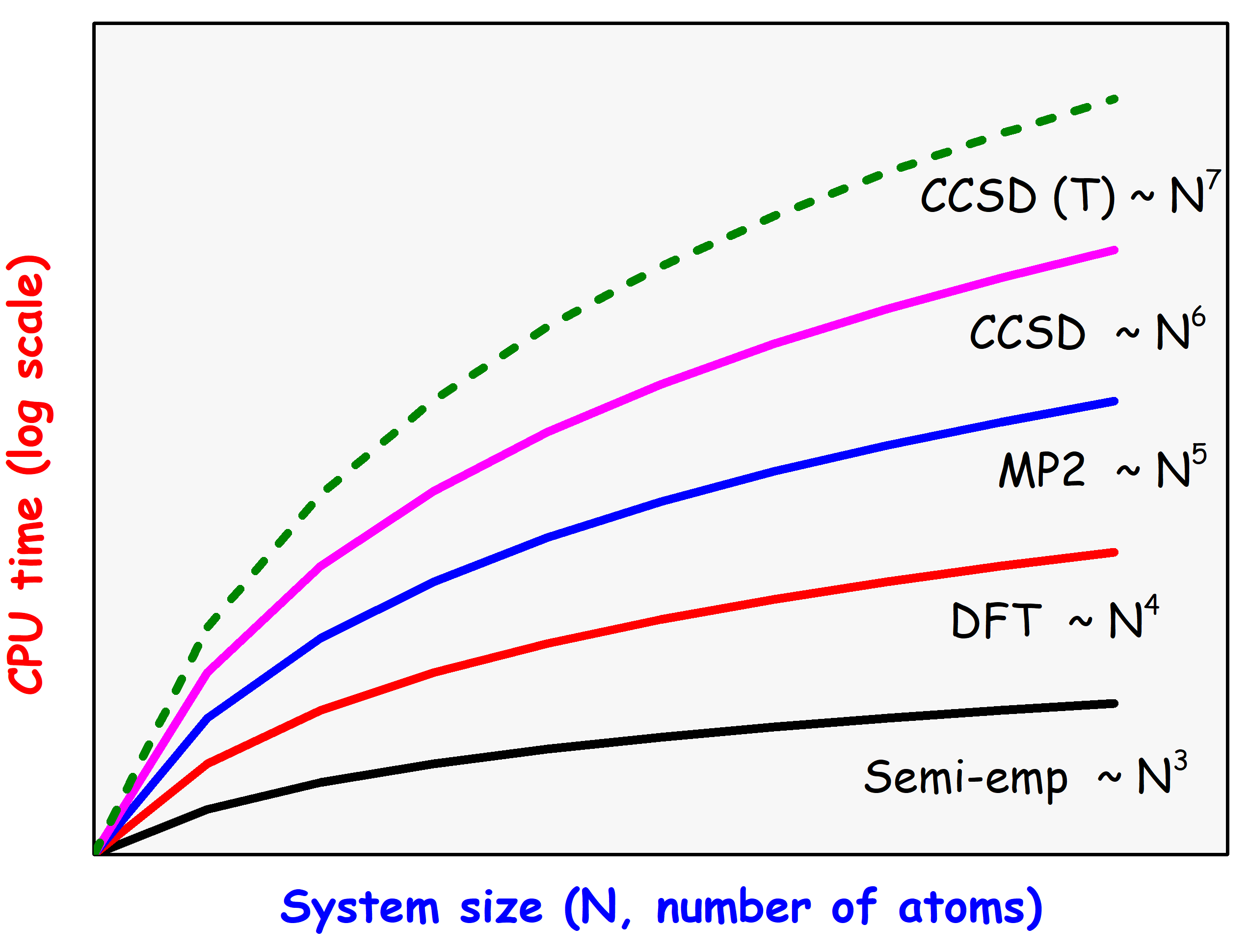
As we move up Jacob’s ladder, more physical information is included, improving the description of exchange-correlation. Although DFT relies on approximate functionals, it offers an excellent balance between computational accuracy and cost (approximately scaling, where represents the number of atoms). Therefore, it is widely used in studying larger molecules, solids and condensed matter systems.
Coupled Cluster and Relativistic Coupled Cluster
For highly accurate calculations, especially when electron correlation effects are substantial, Coupled Cluster (CC) Theory was developed as one of the most compelling and systematically improvable approaches. The method is widely recognised as the benchmark, or “gold standard” for molecular energies and related properties.
Within the CC scheme, the correlated wavefunction is expressed using an exponential ansatz in the form of
where is the cluster excitation operator that accounts for electron correlation effects through a hierarchy of excitations built upon the reference Slater determinant [20]. In practical applications, the expansion is commonly truncated to obtain computationally feasible methods such as coupled cluster single and double excitations (CCSD) and coupled cluster single and double excitations including perturbative triple excitations (CCSD(T)). These methods frequently yield molecular energies and related properties with near experimental accuracy, especially for small and medium-sized molecular systems.
Figure 3 presents the computational scaling of widely used electron structure methods. The steep growth in computational expense with increasing system size N underscores the difficulty of extending highly accurate correlation-based approaches to large molecular systems.
The standard CC starts from a single HF reference, which assumes one electronic configuration dominates. This breaks for systems exhibiting near-degeneracy effects, such as bond dissociation or strongly correlated electronic states. Thus, multireference extensions of CC become necessary. It captures both static and dynamic electron correlation effects within a unified framework[21-22].
Beyond energies, CC theory is extended to compute molecular properties analytically, dipole moments, polarizabilities, NMR shielding, spectroscopic constant and more. The Z-vector method makes this an efficient method[23]. It solves a linear response equation and computes all first-order properties rather than differentiating the CC wavefunction.
For systems having heavy elements, relativistic effects become necessary for achieving accurate theoretical predictions. The most famous example is that gold and silver are predicted to exhibit similar chemical and optical properties. But the relativistic correction of the 6s orbital of gold results in the change in s-d orbital energy gaps, which directly explains gold’s anomalous optical appearance and chemical behaviour. Relativistic effects are also crucial in phenomena such as parity non-conservation [24] and electron electric dipole moment studies in heavy molecules like HgF [25].
To consistently incorporate both relativistic and electron correlation effects in a consistent manner, CC theory is extended to the relativistic coupled cluster framework (RCC). Together with response theory approaches such as Z vector methods, RCC enables highly accurate calculations of spectroscopic and electromagnetic properties, including hyperfine constant, transition moments and parity violation interactions [26-27]. Consequently, relativistic quantum many-body methods have become indispensable tools in modern quantum science and precise quantum measurements.
Next Century of Quantum Mechanics
The modern quantum mechanics is increasingly moving towards highly accurate and scalable approaches based on advanced many-body methods such as CC theory and its relativistic extensions. These methods provide a rigorous description of electron correlation and chemical bonding, often achieving near experimental accuracy even for heavy element systems and strongly correlated materials. At the same time, machine learning techniques are being incorporated to accelerate electronic structure calculations while preserving first-principles accuracy. Overall, the field is evolving towards a combination of quantum many-body theory and data-driven methods, enabling reliable prediction of molecular and material properties.

Dr Anu Arora is a postdoctoral researcher at Ashoka University, Sonepat, and she works with Prof. Sourav Pal. Her research interests include computational quantum material science, particularly first-principle studies of spin-polarised phenomena and their applications in spintronics, quantum materials and energy conversion applications.
Prof. Sourav Pal is a leading theoretical and computational chemist, right now serving as Head of the Chemistry Department at Ashoka University, Sonepat. His work focuses on the development of new methodologies and conceptual frameworks in many-body electronic structure theory, density-based approaches to chemical reactivity, along with the investigation of catalytic as well as hydrogen storage materials, through computational material science.
References
- Rayleigh, Lord. (1900). Remarks upon the law of complete radiation. Philosophical Magazine, 49(301), 539–540.
- Planck, M. (1900). Über eine Verbesserung der Wienschen Spektralgleichung. Verhandlungen der Deutschen Physikalischen Gesellschaft, 2, 202–204.
- Einstein, A. (1905). Über einen die Erzeugung und Verwandlung des Lichtes betreffenden heuristischen Gesichtspunkt. Annalen der Physik, 17, 132–148.
- Bohr, N. (1913). On the constitution of atoms and molecules. Philosophical Magazine, 26(151), 1–25.
- Sommerfeld, A. (1916). Zur Quantentheorie der Spektrallinien. Annalen der Physik, 356(17), 1–94.
- Zeeman, P. (1897). On the influence of magnetism on the nature of the light emitted by a substance. Philosophical Magazine, 43(262), 226–239.
- Stark, J. (1914). Beobachtungen über den Effekt des elektrischen Feldes auf Spektrallinien. Annalen der Physik, 348(7), 965–982.
- Heisenberg, W. (1925). Über quantentheoretische Umdeutung kinematischer und mechanischer Beziehungen. Zeitschrift für Physik, 33, 879–893.
- Heisenberg, W. (1927). Über den anschaulichen Inhalt der quantentheoretischen Kinematik und Mechanik. Zeitschrift für Physik, 43(3–4), 172–198.
- Born, M., & Jordan, P. (1925). Zur Quantenmechanik. Zeitschrift für Physik, 34, 858–888.
- Born, M., Heisenberg, W., & Jordan, P. (1926). Zur Quantenmechanik II. Zeitschrift für Physik, 35, 557–615.
- Heitler, W., & London, F. (1927). Wechselwirkung neutraler Atome und homöopolare Bindung nach der Quantenmechanik. Zeitschrift für Physik, 44, 455–472.
- Born, M., & Oppenheimer, R. (1927). Zur Quantentheorie der Molekeln. Annalen der Physik, 389(20), 457–484.
- Hartree, D. R. (1928). The wave mechanics of an atom with a non-Coulomb central field. Proceedings of the Cambridge Philosophical Society, 24, 89–110.
- Fock, V. (1930). Näherungsmethode zur Lösung des quantenmechanischen Mehrkörperproblems. Zeitschrift für Physik, 61, 126–148.
- Slater, J. C. (1929). The theory of complex spectra. Physical Review, 34, 1293–1323.
- Hohenberg, P., & Kohn, W. (1964). Inhomogeneous electron gas. Physical Review, 136(3B), B864–B871.
- Kohn, W., & Sham, L. J. (1965). Self-consistent equations including exchange and correlation effects. Physical Review, 140(4A), A1133–A1138.
- Perdew, J. P., & Schmidt, K. (2001). Jacob's ladder of density functional approximations for the exchange-correlation energy. AIP Conference Proceedings, 577, 1–20.
- Čížek, J. (1966). On the correlation problem in atomic and molecular systems: Calculation of wavefunction components in Ursell-type expansion using quantum field theoretical methods. Journal of Chemical Physics, 45, 4256–4266.
- Pal, S., Rittby, M., Bartlett, R. J., Sinha, D., & Mukherjee, D. (1988). Molecular applications of multireference coupled-cluster methods using an incomplete model space: Direct calculation of excitation energies. Journal of Chemical Physics, 88, 4357–4366.
- Mukherjee, D., & Pal, S. (1989). Use of cluster expansion methods in the open-shell correlation problem. Advances in Quantum Chemistry, 20, 291–373.
- Salter, E. A., Trucks, G. W., & Bartlett, R. J. (1989). Analytic energy derivatives in many-body methods. I. First derivatives. J. Chem. Phys., 90, 1752–1766.
- Gopakumar, G., Das, B. P., Chaudhuri, R. K., Mukherjee, D., & Hirao, K. (2001). Relativistic coupled-cluster calculations of parity non-conservation by the sum-over-states approach. Phys. Rev. A, 64, 052507.
- Talukdar, K., Nayak, M. K., Vaval, N., & Pal, S. (2019). Relativistic coupled-cluster investigation of parity (P) and time-reversal (T) symmetry violations in HgF. Journal of Chemical Physics, 150, 084304.
- Sasmal, S., Pathak, H., Nayak, M. K., Vaval, N., & Pal, S. (2015). Implementation of the Z-vector method in the relativistic coupled-cluster framework to calculate first-order energy derivatives: Application to the SrF molecule. Physical Review A, 91, 030503.
- Sasmal, S., Talukdar, K., Nayak, M. K., Vaval, N., & Pal, S. (2016). Calculation of hyperfine structure constants of small molecules using Z-vector method in the relativistic coupled-cluster framework. J. Chem. Sci., 128, 1671.