Insight Digest | Issue #8
In Insight Digest, we showcase the latest happenings in science research.From Dust to Dynamics: Understanding PM2.5 Variability in Arid Climates Using Wavelet Coherence
Kafy, A.A., Ibrahim, W.M., Baky, A.A. et al. Trends and oscillation characteristics of hourly PM2.5 levels in arid environments using wavelet coherence and lagged correlation. Sci Rep 16, 6827 (2026) (20MS IISER Kolkata) Subjects: Twisted bilayer graphene, superconductivity, strong-correlationsThis paper presents a comprehensive analysis of the temporal variability and meteorological controls of PM2.5 concentrations in Kuwait City, an archetypal arid urban environment. Using high-resolution hourly data from 2017–2024, the authors combine advanced statistical and signal-processing techniques—including wavelet coherence, lagged correlation, and non-parametric trend analysis—to capture both multiscale oscillations and long-term trends in air pollution.
The study successfully demonstrates pronounced diurnal and seasonal variability in PM2.5 levels, with peak concentrations occurring during summer evenings (notably around 7 PM in July) and comparatively lower levels during winter mornings. These patterns are convincingly linked to boundary-layer dynamics, dust resuspension, and anthropogenic activity. At longer timescales, the application of Mann–Kendall and Theil–Sen estimators reveals a general declining trend in PM2.5, although statistical significance is limited to specific months (notably September), suggesting that improvements in air quality may still lie within natural variability bounds .
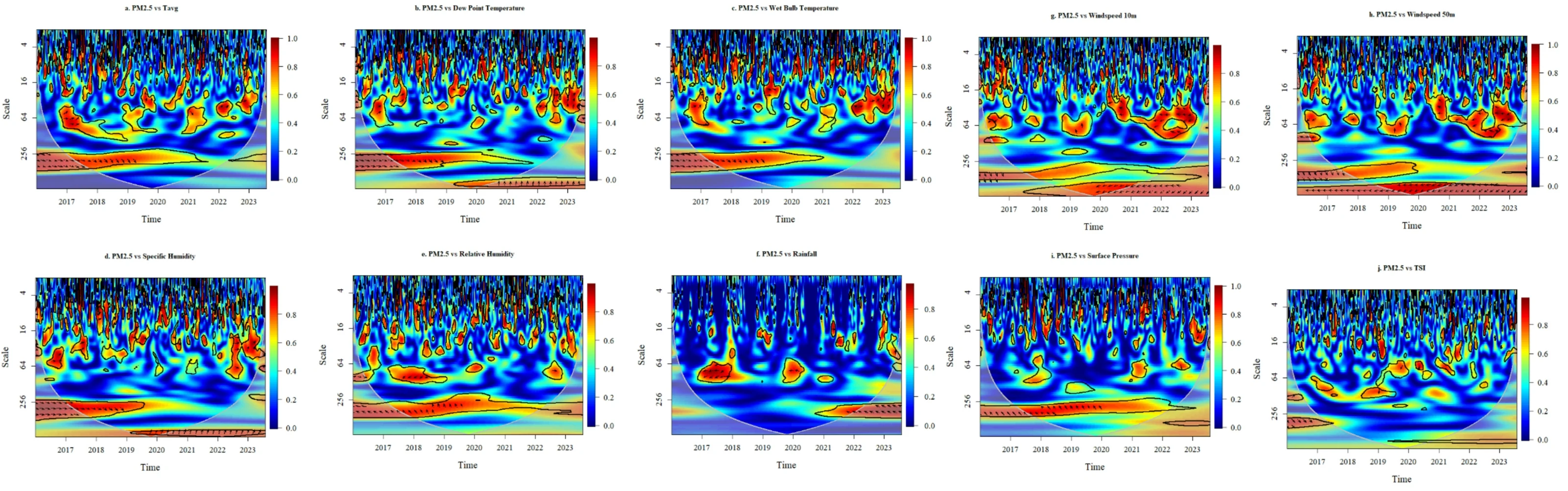
A key strength of the paper lies in its use of cross wavelet transform (XWT), which effectively captures scale-dependent relationships between PM2.5 and meteorological variables. The results highlight strong in-phase coherence with temperature, humidity, and related thermodynamic variables at seasonal scales (100–300 days), reinforcing the role of climatic forcing in aerosol dynamics. Additionally, lagged correlation analysis provides valuable insight into delayed atmospheric responses, with peak influences ranging from ~10 to 30 hours depending on the variable. This temporal lag is particularly relevant for forecasting and suggests that PM2.5 dynamics are governed by cumulative and nonlinear processes rather than instantaneous interactions.
The multivariate regression framework further supports these findings, identifying wind speed, rainfall, humidity, and solar irradiance as significant predictors. However, some relationships (e.g., rainfall showing both positive and negative associations depending on scale) highlight the inherent complexity of aerosol–climate interactions in desert environments.
Despite its methodological rigor, the study has notable limitations. The absence of vertical atmospheric structure (e.g., boundary-layer height) and satellite-derived aerosol data (AOD) constrains the interpretation of transport and mixing processes. Moreover, the lack of source apportionment prevents differentiation between natural dust and anthropogenic emissions, which is critical in arid regions. Addressing these gaps could substantially enhance the robustness of the conclusions.
Overall, the paper makes a strong contribution by integrating high-resolution data with multiscale analytical tools, offering nuanced insights into PM2.5 dynamics in arid climates. Its findings are particularly relevant for air quality forecasting, renewable energy planning, and climate adaptation strategies, although future work incorporating vertical dynamics and source-specific analysis would further strengthen its applicability.