Macroscopic Quantum Phenomena : The Story of 2025 Physics Nobel
Giants and Lilliputians
Remember how Gulliver ended up first in the land of tiny people, and then in the land of giants? The two countries had completely different social norms. Well, the same is there in the physical world, too! in our everyday life, everything is governed by laws of Classical Mechanics. Starting from how a stone thrown upwards falls back to the ground, to how an accelerated car moves, to planetary motion, satellite launching: the gospel of Newton has it all! At the opposite end of the spectrum, there is the world of the small — atoms and its constituents: electrons, protons, neutrons. In that world, the laws of Quantum Mechanics rule supreme. The quantum particles often show behavior that would be deemed strange, or even impossible in the classical world.
Can the twain ever meet? Can the quantum laws govern classical systems, if they are tailored suitably? Let’s take a look at the Nobel prize for Physics, 2025. It was awarded to John Clarke, Michel H. Devoret, and John M. Martinis. As per the press release of the Nobel Committee, the recognition is “ for the discovery of macroscopic quantum tunneling and energy quantization in an electrical circuit. “ So there are three distinct key-words (or, maybe key phrases!) involved : “macroscopic”, “quantum tunneling”, and “energy quantization”. “Macro” means large, as opposed to the small – “Micro”. Evidently, the work behind this prize somehow bridges the world of the giants (i.e., “Macro”) and the Lilliputians (i.e., “Micro”). Intriguing, isn’t it?
What really are quantum tunneling and energy quantization? And what does it mean to have them on a macroscopic scale? In this article, we’ll try to find answers to these questions.
Quantum Tunneling
Imagine a ping pong ball lying at the bottom of a big circular tub. Lightly shake the tub, and the ball starts rolling inside it. Even then, the ball cannot escape the tub : because before it stands a tall barrier - the wall of the tub. The kinetic energy of the ball is not sufficient for it to climb over that wall.
Now replace the ball by a tiny particle like an atom, and the tub by a potential well where it is trapped. There is a certain probability that the quantum particle might cross the barrier, and land outside. This is more like the apparition or magical transportation you come across in Harry Potter books or our very own Gupi Gayen Bagha Bayen movies. This is not guaranteed that it will definitely cross the wall, but yes, there is a high chance of it. So if you have hundreds of such particles, maybe ten or twenty will “Break on through the other side”.
This is quantum tunneling.
Energy Quantization
And Energy quantization?
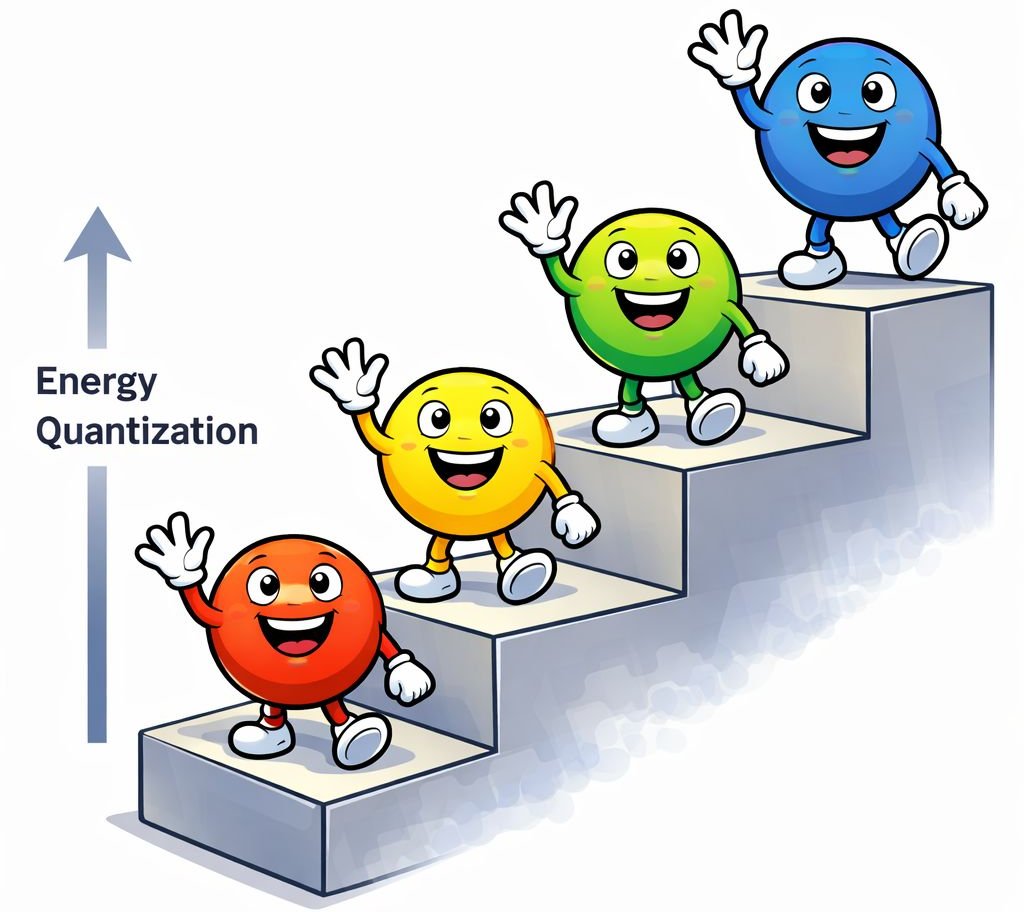
Quantum mechanics says that such tiny particles cannot have arbitrary energy values. They have specific allowed energies — like the steps of a staircase. Just like you cannot stand in the intermediate region between two steps of a stairway, atoms, too can stay on the distinct energy levels only : not midway.
But all of these are familiar textbook material : essentially, the primer of quantum mechanics. The very ideas of quantum tunneling and energy quantization date back to a century. In fact, the pioneers of quantum theory : Planck, Einstein, Bohr, de Broglie, Heisenberg, Schrödinger, Dirac, Pauli — all were honored with Nobel Prizes long back.
So what is the big deal this time? What led to another Nobel prize?
The novelty lies in the word “macroscopic.” It takes us back to the giant vs. Lilliputian conflict again. The Liliputian particles obey quantum mechanics, and the giant particles do not.
What if one fine morning you see a giant macroscopic system to follow quantum rules? Will not that be astonishing… something like a new world order?

Superconductivity, Superfluidity, and Condensates
Interestingly, macroscopic quantum behavior is not, in itself, new either. At very low temperatures, some metals suddenly lose electrical resistance, an effect known as superconductivity. Liquid helium becomes a superfluid at 2.17 Kelvin, and demonstrates a flow without viscosity. If we think carefully, what superconductivity is for charged particles, superfluidity is for charge-neutral ones. That they support dissipation-less low (current flow in the former, particle flow in the later) can be attributed to the collective movement of the constituent particles. When cooled enough, these tiny balls all start moving in perfect synchrony, like the lockstep marching of soldiers. As a result, there are no collisions, no scattering of particles (nobody is going to bump into a fellow soldier in that parade) : only streamlined motion ahead.
Bose–Einstein condensation, (named after Satyendra Nath Bose, and Albert Einstein) is another fascinating phenomenon. Bosons , i.e., particles with integer spins, condense to the lowest momentum state collectively. In spirit, these condensates belong to the same family as that of superconductors and superfluids. These all are quantum phenomena, observed on a macroscopic scale. Unlike the electrons and protons that you cannot see with your bare eyes, you can see how a superconducting circuit functions or a superfluid rises up the capillary well in our lab environment.
Here is a catch again. These are undoubtedly manifestations of quantum physics, emerging in a macro system. However, the real culprits behind such occurrences are micro again : electron pairs (average distance between those electrons : 10-100 nm), bosonic atoms (radius : fraction of a nm), etc. What if it could be demonstrated that a large object itself can behave the way a quantum particle does? If we find that the effect arises not merely because the constituent particles follow quantum mechanics, but because the large system itself, as a whole,show clear quantum signatures? That would be even more remarkable. Clarke, Devoret, and Martinis precisely did this.
It’s all about Scales
The terms “Giants” and “Lilliputians” : or even, “Large” and “Small” are, in fact, misnomers. Classifying a system as large immediately raises the question : large with respect to what? Similarly, calling a system small is meaningful only relative to a chosen reference. So one needs to ask : is it larger or smaller than some predefined scale or object?
So if we say, micros are quantum, and macros are classical : that would be an oversimplified picture. Rather, let’s talk about energy scales. A system exhibits quantum behavior when the relevant quantum energies exceed the competing classical scales. For a single particle (in the quantum domain, it is capable of displaying both particle and wave natures) : the comparison should be between the de Broglie wavelength (the wavelength associated with the “wave” nature of a particle), and system’s other length scales. For a collection of particles, one might need to check the competition between quantum fluctuations, and thermal fluctuations.
Thermal fluctuations result from random motion of particles : a temperature effect. Quantum fluctuation has its roots in Heisenberg’s uncertainty principle : there will always be some fluctuation in position, momentum of the particle even if you freeze it to absolute zero of temperature. If in a system the thermal fluctuation overpowers its quantum counterpart, the system is predominantly classical. If, on the other hand, the quantum fluctuation overrides the classical ones (this is what happens for small particles, at very low temperatures : that is why superconductivity, superfluidity and Bose Condensation all occur at near-zero temperature ranges), we see the live demonstration of quantum mechanics.
Clarke and team used a classical circuit to mimic a quantum system like an atom, and engineered it such a way that the corresponding “quantum-like” energy scales dominate over the thermal scale. This is the key to the macroscopic quantum behavior they observed.
Simulating an Atom
How a system can mimic another?
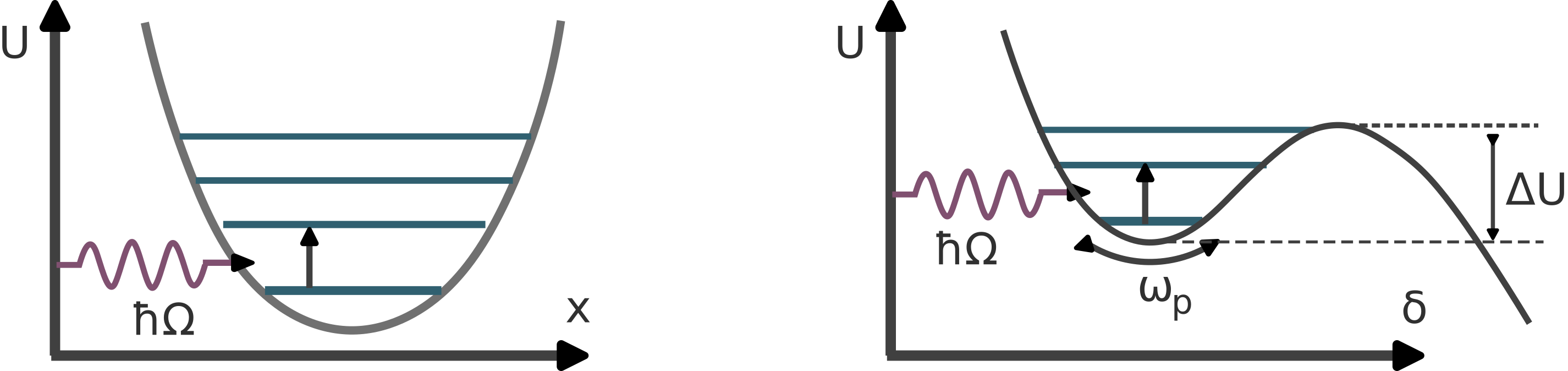
Simple. If two systems, however distant, follow same form of mathematical equation, one can be used to “simulate” the other. Meaning, by studying one of them, we can deduce the properties of the other. Take, for example, an inductor-capacitor circuit follows the same equation as that of a spring-mass harmonic oscillator system. If the parameters (inductance, capacitance, temperature) can be chosen accordingly, it can even yield a “quantum harmonic oscillator” : if the discrete level spacings (distance between the steps of the energy staircase) is higher, compared to the thermal energy scale.
Similarly, the differential equation describing the dynamics of a Josephson junction with self-capacitance can be shown to be equivalent to the equation for a point mass in the one-dimensional tilted cosine potential. A Josephson junction consists of two superconductors are separated by a thin insulating barrier. Wonder of wonders : through this junction, an electrical supercurrent can flow even without any applied voltage! This miraculous effect was predicted by Brian Josephson using laws of quantum mechanics, and was later realized experimentally.
This junction was an essential ingredient in the experiment conducted by Clarke, Devoret, and Martinis.
The Experiment
Around 1984–1985, the trio carried out a series of laboratory experiments. At that time, Clarke was the supervising professor, Devoret a postdoctoral researcher, and Martinis a PhD student. Their experiments unveiled a new generation of quantum-mechanical behaviors : that on a macroscopic scale.
How did they come up with the idea? Well, Science never advances through sudden, unprepared miracles. Clarke’s work was grounded in decades of theoretical and experimental studies. Theoretical physicist Anthony Leggett (he won Nobel prize for his works on superfluidity) suggested this possibility in 1980, distinguishing two kinds of macroscopic quantum phenomena: (1) where a large object behaves strangely because its microscopic constituents obey quantum mechanics (like superconductivity, superfluidity), and (2) where the large object itself shows quantum behaviour . Clarke’s 1985 experiments attempted to demonstrate the second. The team numerically simulated the experiment beforehand with help from Daniel Estève to identify the exact range of parameters. Thus, theory, experiment, and computater simulation — the three pillars of modern science — all played essential roles in this discovery.
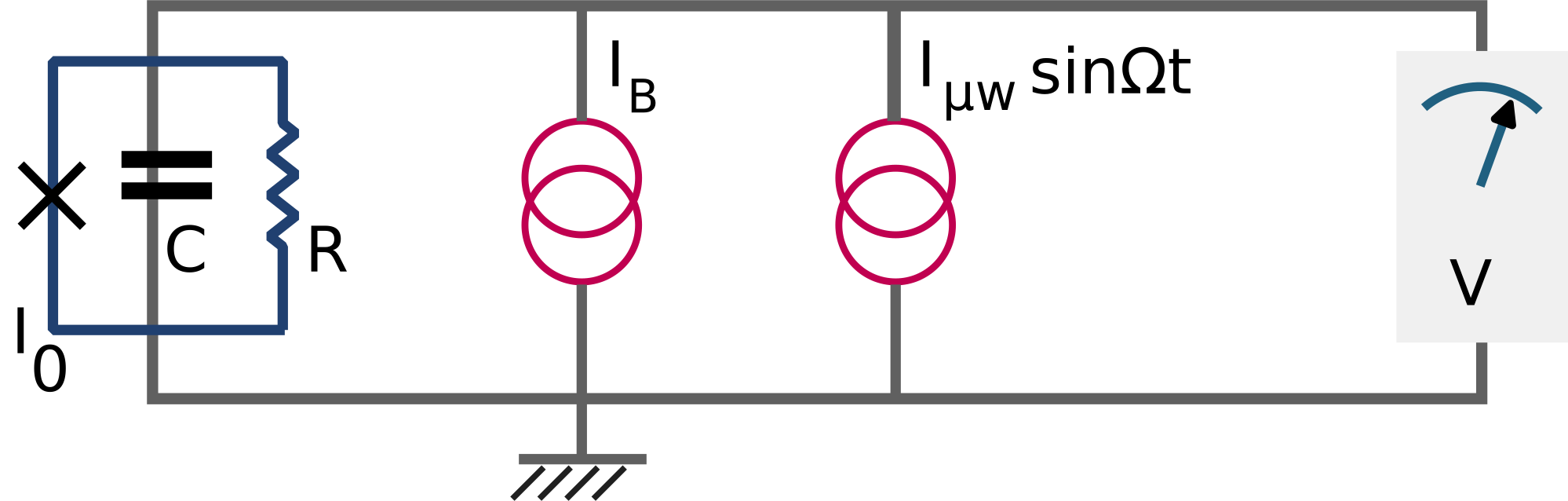
Clarke and his team fabricated Josephson junctions on oxidized silicon chips by layering specific materials. They connected the junction to a current source, a microwave radiation source of fixed frequency, and a voltage meter. The entire experiment was conducted at extremely low temperatures — in the milliKelvin range.
Because it was a Josephson junction, they observed current flowing even without any applied voltage. This zero-voltage state is the junction’s initial and most stable configuration — like the ball trapped at the bottom of a parabolic potential, or, in this particular case, at one of the minima of the cosine potential.
Now recall that ping pong ball. Classical mechanics forbids it from climbing out. Yet a quantum version could escape via tunneling.
In the Clarke–Devoret–Martinis experiment, the junction did escape from the zero-voltage state to a finite-voltage state — by tunneling through the energy barrier, exactly like a quantum particle . How much of that tunneling occurred? Since the “trapped” system corresponds to the zero-voltage state, any non-zero voltage appearing in the voltage measuring amplifier implies a tunneling of the system from it, and can directly measured this “escape rate”.
So non-zero voltage meant that quantum tunneling was occurring — the state of a system has tunneled.
This is the quantum-like state arising from a macroscopic object, right? The Josephson junction itself was small (10 micrometer X 10 micrometer), but the full circuit was of the scale of centimeter : something that you can comfortably hold on the palm of your hand. The temperature was not too cold either : certainly not the nanoKelvins or picoKelvins one requires for realizing Bose-Einstein condensation and related stuff.
But the story doesn’t end there. Remember energy quantization, i.e., he staircase of energy levels? The zero-voltage state is like the lowest step. In principle, the junction could occupy higher steps too — step 1, step 2, and so on. If energy is supplied externally, the system can climb the steps. And once it climbs higher, escaping the potential well become even easier.
Martinis applied microwaves. Remarkably, the voltage, i.e., the tunneling probability, sharply increased at exactly three specific current values, and not at intermediate ones. This meant the system had climbed to particular higher energy levels before the tunneling took place . Just like atoms, the Josephson junction circuit behaved as if it possessed discrete quantum energy states. In effect, it acted like an artificial atom.
What’s Next?
The range of applications is vast. If you can design a circuit that can mimic the properties of an atom, you end up having highly controllable “artificial atoms”. Whatever you aspire to do using an atom by exploiting its quantum mechanical features, you can do it now using the circuit, and with much better precision. An atom that can stay in either of its two lowest energy levels can function as a qubit : with states |0 > and |1 >. The same can be achieved with this Josephson junction circuit, utilizing its ground state and the first excited state. Only now, the controlling knobs are much more efficient : one can simple change the resistance or capacitance , or the microwave frequency to change the state of the system as per need. Thus, such a Josephson junction circuit can be employed as versatile platforms for quantum computation.
These systems also hold potential for more application-oriented areas such as quantum teleportation (a protocol that transfers quantum information across a distance) and quantum cryptography (ensuring secure communication using principles of quantum mechanics).
Even if we put aside the application aspects, Clarke and team’s work does not lose its significance. For, this work is also about the fundamental nature of physics. It springs from the very premise quantum mechanics was built upon, and probes our basic understanding of matter. The demonstration that a quantum effect can be harnessed and controlled in an otherwise classical circuit marks a profound step forward, and adds to humankind’s eternal quest for deciphering the grammar of this universe.
Some schematic illustrations in this article were created using generative AI tools (ChatGPT, OpenAI).

Raka Dasgupta is a theoretical physicist, engaged in both teaching and research. Presently she is an Assistant Professor at Dept. of Physics, University of Calcutta. Her broad research interests include quantum many-body physics and statistical physics. She is also an acclaimed poet and has been honored with the Krittibas Puraskar, the Bangla Academy Award, and the Yuva Puraskar from the Sahitya Akademi of India.
References
- Press Release, Nobel Prize in Physics 2025
- M.H. Devoret, J.M. Martinis, & J. Clarke (1985), Physical Review Letters, 55(18), 1908.
- M.H. Devoret, J.M. Martinis, & J. Clarke (1987), Physical Review B, 35(10), 4682.
- J.M. Martinis, M.H. Devoret, & J. Clarke (2020), 16(3), 234–237.
- A.J. Leggett (1980), 69, 80–100.
- Johanna L. Miller (2025), Physics Today