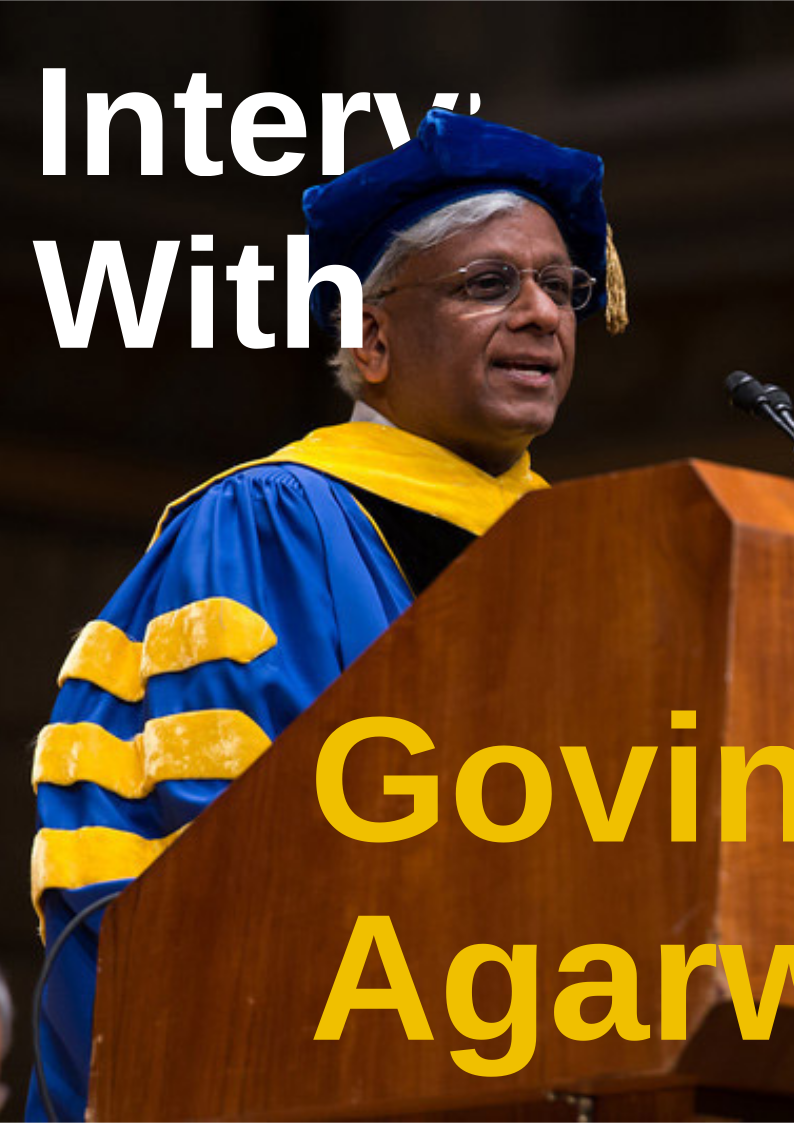
Interview With Prof. Govind Agarwal: A Pioneer In Nonlinear Optics
DC: First I would like to ask about your childhood a bit. Where did you grow up and how was your childhood days and how did you get inspired to become a scientist?
GA: So, I grew up in a small town called Kashipur. At that time it used to be in Uttar Pradesh but nowadays it is part of Uttarakhand. So at that time the population was only about 30,000 people. I come from a business family. We were a very lower-middle-class kind of family. So childhood was pretty simple, nothing very special. My father wanted me to take over the shop, work with him, I mean later on. But I was not interested in that. I hated business and so I wanted to really get out of that place and I thought education was the only way for me to do that. So it’s very early on that I discovered that I was good in math and I started getting good grades. In the primary schools and throughout I was number one every time. So my father realized that it would be better for me to probably go out to study and that was because he wanted to do that when he was young. He tried to go to Allahabad for a degree but he came from a very poor family and his health gave up. I think he was very happy that I could do the education.
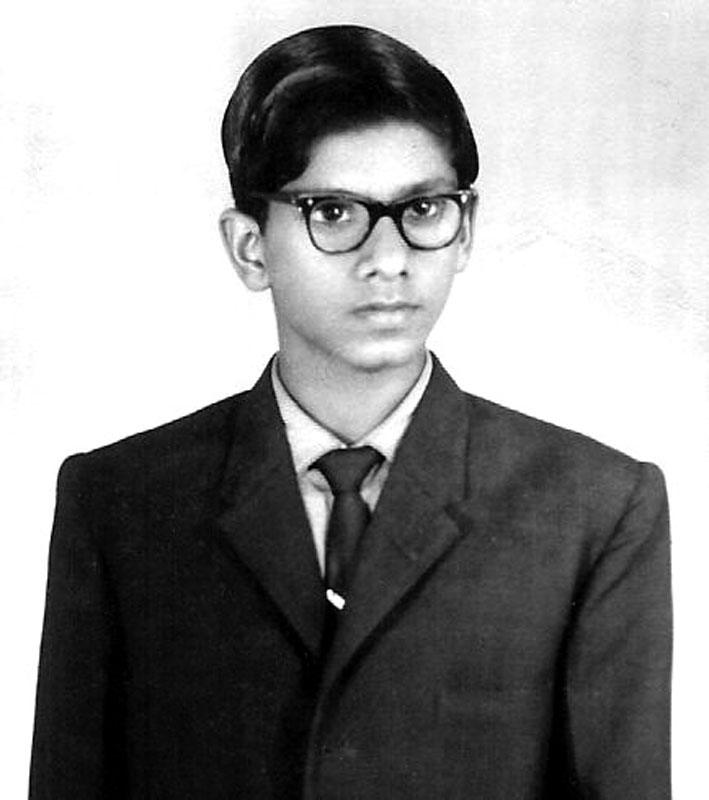
Now how did I come towards science? So when I came to high school in the 9th grade I was only 12 years old because I was two years early everywhere. In those days you had to make a choice between science track, liberal arts and commerce track in 9th grade and I had no idea what to do at that point. So I inquired with lots of people and everybody simply said if you want to live a decent life with a good salary then choose the science track. So without knowing anything I picked the science track. And it turns out I was good at science. I started liking physics. I was very good at math. So for that reason I just stayed with science and then for my bachelor’s (BSc) I went to Lucknow which is the capital of Uttar Pradesh. And again when I went there normally people took physics, chemistry and mathematics. But I went with the intention of topping the university and several people told me there don’t take chemistry, take statistics because that is like math and you might do better with that. So I ended up doing statistics and maths. And then when I graduated from there, someone told me the best place for you to go is ISI in Kolkata because that’s the best institute in statistics. I was good at statistics. So I applied for ISI and it turns out I made the interview. I got admission in ISI. However, at that time I was very young. When I did my bachelor’s I was 18 years old. In those days Kolkata had lots of Naxalite problems. So my family did not want me to go to Kolkata in that situation. So I ended up coming to IIT Delhi for a master’s in physics.
Then again when I was doing master’s there the question was what subject you want to do PhD in? Everybody told me to do solid state physics, or condensed matter physics. I said okay, so I didn’t take any optics class at all, thinking that I would focus on condensed matter. Then I asked what is the best place to do a PhD and the advice was go to TIFR in Bombay. I said okay let me apply for TIFR and let’s see what happens. But unfortunately it so happened that on the day I was supposed to go to Bombay for an interview on the same day IIT Delhi also had their PhD interview. PhD at IIT Delhi was actually my backup plan, if something didn’t work out at TIFR. So I came to see the department head and I told him that I’m the top student here, so why is this interview necessary? I mean perhaps you can take me without an interview. He was very unhappy and didn’t want to agree to that. But eventually he said if any professor in the department is willing to take you without an interview then he can agree to it. So before leaving for Bombay at 5:00 pm I was looking for some faculty member in the department, and only one room’s light was lit. That was a professor who had come from Rochester recently, his name was Chandra Lal Mehta. He had no students at that time, so I went to see him and asked him if he was willing to take me as a student. He said “you are a top student, I have no one, so sure I’ll take you” and that’s what brought me to optics basically. So again, it was not my desire, it’s just chance that I didn’t make a TIFR interview. I came back to Delhi, did a PhD there and that’s how I came to optics.
DC: So, it was the start of nonlinear optics as well in your PhD days.
GA: I can tell you a little bit there because my advisor Mehta was a student of Emil Wolf in Rochester. So, his field was quantum optics basically. I mean this was a relatively old field and I was a little concerned that if I did a PhD in that area I would not make much progress. So I wanted to do some work in some other area. So I went to the library and started looking and I discovered that nonlinear optics is a new field. So I went to my advisor and said “I want to work in nonlinear optics” and he said “I don’t know anything about nonlinear optics. I’ve not worked in this area so how can I advise you in this area?”. So I suggested to him that I will go to the library, read the material and I will give weekly seminars in the group on nonlinear optics. Based on that perhaps I can do some work in nonlinear optics. That’s why I ended up doing that. So I worked in that area which he was interested in but I also did some nonlinear optics work and that brought me to Paris. So I came to Paris for a postdoc in 1974. That was in nonlinear optics. That’s how I became part of nonlinear optics.
DC: Was there any particular moment in your career which significantly shaped your scientific career or let’s say you started from a well-known path, checking all the boxes, and then some incident happened which took you on a tangent?
GA: Right. Right. Yeah. Yeah. I think there are a couple of things I can think of. One was in high school, I think, where I was not shooting high enough. I mean, I didn’t think I could do very well. So one of the teachers told me, “you can try to become number one”, and I said “but no, I mean I’m not like that. I can’t do that, that is impossible for me..”, so he told me “but why? You have two eyes, two ears, everything like everybody else, so why do you think you can’t do it? You have to change your mindset and think that everything is possible”, and I think that struck me and gave me a kind of confidence. My ambitions became much much higher after that. And the second person I can give credit to when I left Paris for a second postdoc in New York, I had a professor, Melvin Lax, he actually did a lot for me from all points of view. I mean he helped me in every respect. I think whatever I became is because of him in some way. Even my immigration to the US was because of his help. My job finding was because of his help. So he was very helpful in many respects and so the second person would be this person here.
DC: He was your postdoc supervisor?
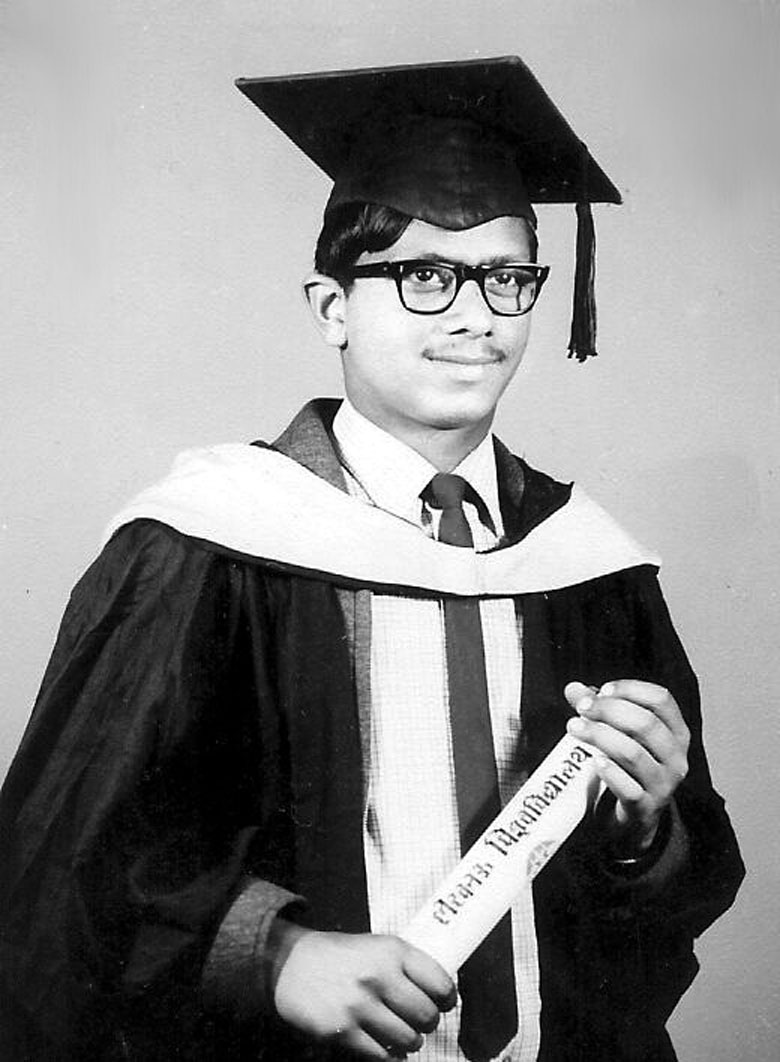
GA: Yeah. He was my postdoc supervisor. I did end up with two postdocs. I mean so the story was, I tried to do a PhD in the United States. So after master’s I applied to the US for PhD and then I got admission in three four places. But my problem was that my TOEFL score was not good. So none of them wanted to give me a research assistantship or teaching opportunity. So they admitted me and they said that I can come for a semester and if I do a semester then they can give me support afterwards. But I come from such a low income family there was no way for me to come there for a semester. So that was a kind of big disappointment for me. But then I thought it’s not a bad thing after all because if I went to the US it would have taken me six years to do a PhD, but if I stayed in India I could finish a PhD in three years. So because of that in July 1974, I got my PhD and I was 23 years old at that time. Then I moved to Paris as a postdoc. So I did a two year postdoc in Paris and then I questioned myself, what do I do now? So I started applying for postdocs in Europe, in the United States, wherever, and everytime just ended up with rejections. Absolutely nothing. So I thought, okay, I’ll have to go back to India. And then one day, something interesting happened. And people should know that doing hard work is not enough, you have to have luck or chance or whatever you call it. I went to the library in France, and I saw the magazine “physical review” and I took it and opened it and suddenly I saw a paper and the author’s name was M. Lax. That name suddenly sounded familiar. How do I know this name? And I could not figure out why I knew this name. But then eventually I remembered that when I got admission (in US) three years before when I was applying for a PhD, at the City University of New York, they told me something like “we recently hired a new professor Melvin Lax, who is very well known and if you change your mind and want to come next year, you can apply again and you can work with him”. So that’s why I remember that name. And because of this relationship, I said to myself, “what do I have to lose? I’m just going to send my CV to this guy”. I mean in those days you just mail them because there was no internet. So I just sent my CV to him with a request for a post and I was not even working in that area. I was working in a totally different area. So I didn’t have high hopes, but believe it or not in 10 days I got a reply back saying “I’m interested, send me your letters of recommendations”. And letters went and I got the offer!
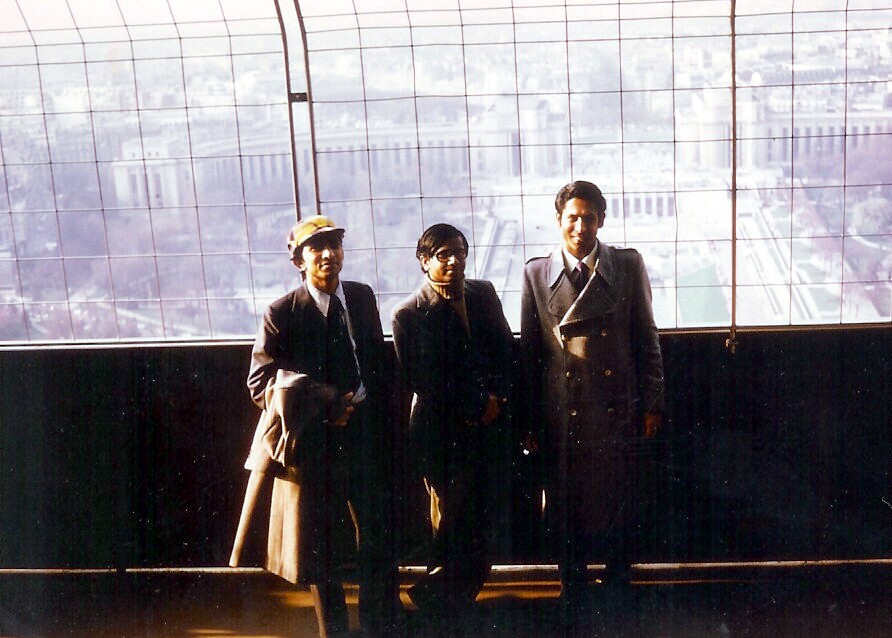
Eiffel Tower, Paris
So that was very surprising to me, how someone I didn’t expect at all gave me a job and I still don’t know fully why it worked out, because I got 20 rejections and suddenly at the last minute when I completely lost hope I got this. That happened to be the best thing for my life. I mean this person was the best person who did everything for me. And here’s another story. So I reached New York to work with this professor and there many Indian students were there and I was talking to them and they were saying “you came to the wrong group, you should not have come here”. They said “Lax does not do physics at all anymore, he’s totally on the computer. His students and postdocs have not published a paper in several years, nobody has been able to publish with him and so you will have problems”. So I got very scared. In fact it turned out to be the truth to some extent because when I went to see my professor for the first time, rather than talking about physics or my problem he told me “I have a magnetic tape that I got from Los Alamos, that I cannot read on the computer here. So your job is to write a computer program that will be able to read this tape here.” And I have never used computers before. I had absolutely no idea what he was talking about!
DC: This was in which year?
GA: 1977.
DC: 1977. Okay. Computers were just beginning to be a thing at that time…
GA: Yeah, Yeah. So I was working mostly with analytic things but I didn’t use computers before. Even in France I was not using computers. And this guy comes and says “I want to write a program in C language or whatever” and this and that, and says “here is the tape, do something, so that I can read it”. And he’s not talking about physics at all. So I was really scared. I didn’t know how to do it, but I could not say no to him. After all, he is my postdoc advisor. So I said “but how would I?”. He said “there’s a terminal here. You will create an account and log into this and then you do it”. I said “but how?” He said “use the editor” and I said “but who is the editor?”. And then he started laughing because I have no idea the editor could be a program and not a person! He said “looks like you’ve not used computers much”. So anyway, he said “okay I give you a month and you do this”. And I did it for him. Basically I learned everything very quickly. So he became impressed to see that within a month I could do his job starting from scratch. And that kind of helped me out later on somehow.
DC: I think we’ll come back to this because one important thing here is to learn very quickly something new.
GA: Yes. Yes.
DC: I’m just curious to know that after doing a PhD in India, why did you choose France? Because France has a big language problem.
GA: Yes. Yes.
GA: So that’s a good point. Let me tell you what happened. When I applied for a postdoc after PhD, I got only rejections from the United States. But I got three positive replies. One was from New Zealand, one was from Italy and one was from France. And I was inclined towards New Zealand. Because New Zealand had no France-level language issue, and I guess I had no idea which one would be best. I mean because all the professors were pretty good. When these offers came to me I was at Raman Research Institute in Bangalore. I was visiting them for a month because I had applied there and they said why don’t you come and spend a month here before we make you an offer. So there I made an appointment with the director of the Raman Institute and I went to see him. I said that I have several postdoc offers. I’m thinking of going for a postdoc. I can come back to you later on if you want. And right now I have these three offers and I’m wondering where to go. And it turns out that the wife of this director was a French woman. So he knew about French culture and about France. So he looked at my offers and he told me that “out of these, to me it looks like the French one is the best. Because financially and the kind of lab you’re going to, they make much better sense”, and he also told me “if you go to New Zealand you will kind of get lost there, because it’s so isolated”. So he basically pushed me towards France.
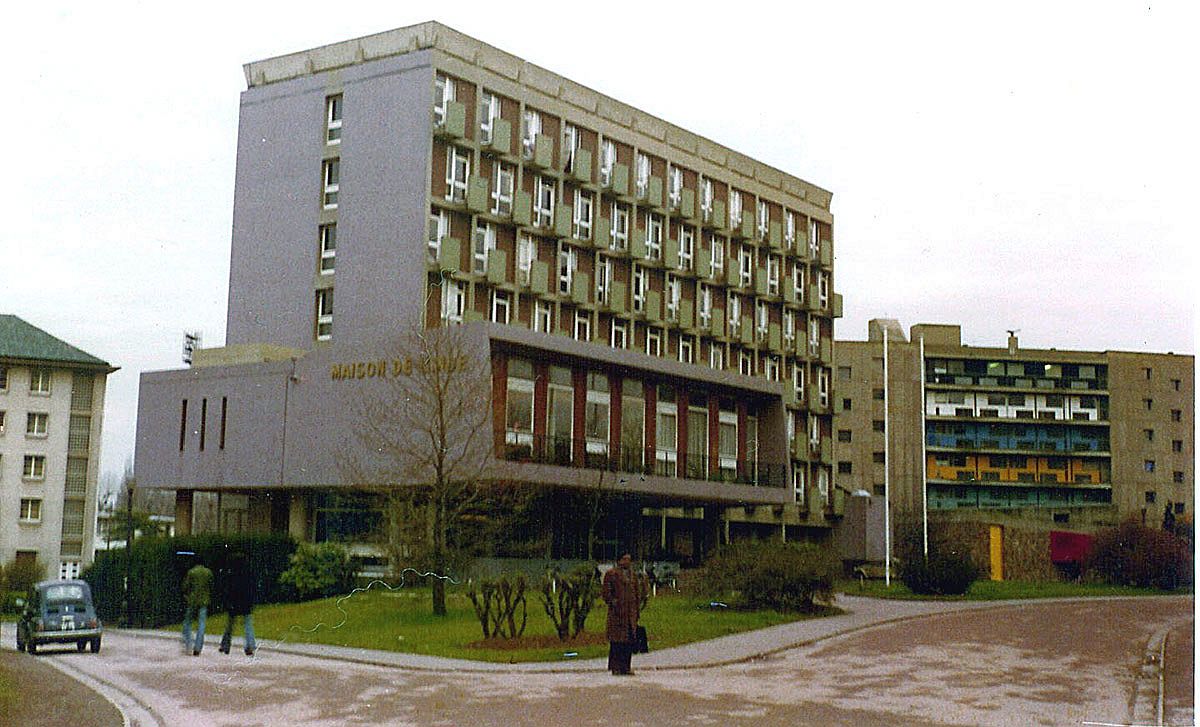
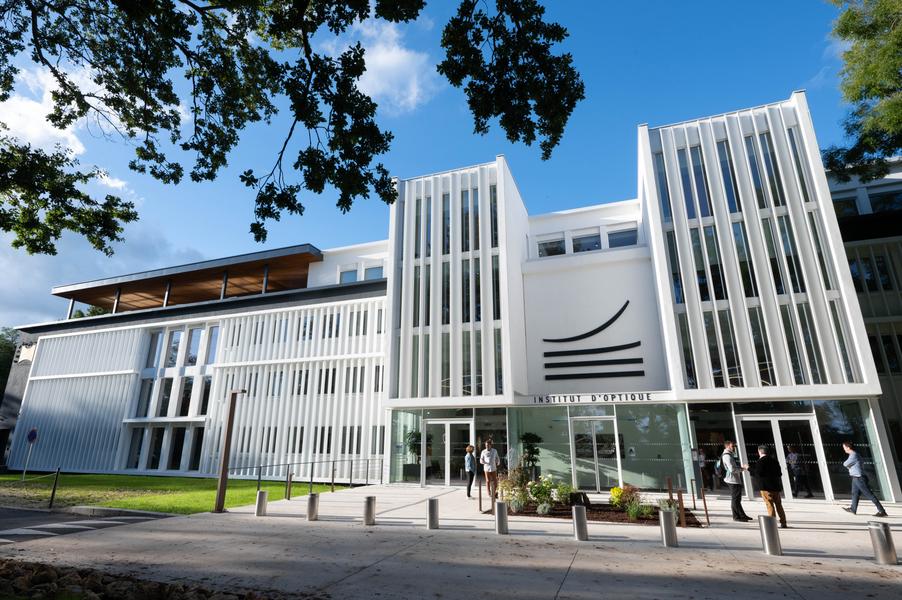
So I said, okay I’ll try to go to France then. But when I came to France immediately I had a huge issue. So let me tell you my experience of the first day in France. I landed at 8:00 am in the morning at the Charles de Gaulle airport. The airport was very new, just opened a few months ago. In those days they would not give me a lot of foreign currency because India did not have a lot of foreign currency reserves. So all they gave me was 40 Franks. I had 40 Franks in my pocket and that’s all I had. And there was absolutely no other money of any kind. And I had written to get a room in a place called the Maison de l’Inde (India House) which is a part of Cité Universitaire (a residential area in Paris, for student expats). I had also written a letter to my advisor saying that I’m coming and I will join you soon. So after I landed in Paris, I inquired and they said if you want to go to Cité Universitaire, you have to take the Air France bus. After paying for the bus I was left with 10 Franks. Then I had to take a metro. I didn’t know the French language but somehow I managed to arrive at the Cité Universitaire and went to the Maison de l’Inde. I told them that I have written a letter and I would like to get the room there. They told me there’s been a postal strike for the last two months here and there’s no delivery so we have no idea. There’s nothing for you here. There’s no room here because we didn’t get your request. So that was my first bombshell. It happened to me at around maybe 10:30 am in the morning. I said okay, if that’s the case then maybe I should go to see my professor. So somehow I figured out how to get there by talking to people. This was in Orsay, so I had to take a train. I had just enough money to buy the roundtrip train ticket and I had nothing left in my pocket. I went to Orsay and I walked over to the street of Institut d’Optique. Over there I talked to the secretary in English and she didn’t know English very well. I showed my letter of appointment. I showed her the name of the professor and the lab I’m supposed to work at and she said “but this professor does not work here”. I said, “but this letter shows you that he should be here!” She said, “I don’t understand what you’re saying, but I can guarantee you there’s nobody with this name here”. I looked around, tried to talk to some other people there, but nobody responded. So, I didn’t know what to do. I simply came back to the Maison de l’Inde. By now, it’s about 4 pm. I’ve not eaten the whole day. I have no money in my pocket. I have no place to sleep. So I asked the guy at the reception, “what do I do? This is my situation”. He said that one option is that he can call the Indian consulate. They will probably send me back to India. They will come and pick me up and send me back to India and ask my parents to pay for the plane fare. I said “I won’t do that yet”. So I was just sitting in the reception area, feeling very sad and rejected and it was dark outside (by 4:00 pm in France it is dark in December). And here is the amazing thing about being in Maison de l’Inde. Somebody noticed me. He came to me and he said “you look very sad, what is the problem?”. So I explained all this to him and he said “okay let me think if anybody from IIT Delhi is around here or not”. So after some time he said there’s a Sikh guy who lives in Maison du Portugal (Portugal House) nearby. He said maybe you can try to go and find him.
So I went and found the room and his wife opened the door and I told her that I want to see her husband and she said that he’s still working. So I had to wait there for a couple of hours. He came back around 7:00 pm and here is a very interesting part which is sort of a surprise to hear. This guy was working at the Institut d’Optique, the same institute where I am supposed to work and where I went a couple of hours ago. And look, here’s luck! So when I explained to him and I told the professor’s name he said yeah he used to be there but he moved to another institute called Ecole Polytechnique a few months ago. So it’s true that he’s no longer there. So now everything made sense to me suddenly. So this guy again I would say is one of the guys whom I should credit, because he did everything for me. He said “have you eaten anything?” I said “no”. So he gave me food. Then he took me to a hotel and booked a room for me (he spoke French). Then he found someone who worked with the same professor I was supposed to work with, and the next day I could visit my professor. My professor was happy to see me, but he didn’t know I was coming. He said “tell me something, do you need money?” And I said “yes I do”. So he took me to some place and he asked someone to give me my first month’s salary. So once I got the money my problem was solved, I didn’t have to worry about anything.
DC: My next question is about your book: Nonlinear Fiber Optics. It’s a very well-known and very well-cited book. What is the story behind this book? What motivated you to write a book? Did you anticipate the impact that it has?
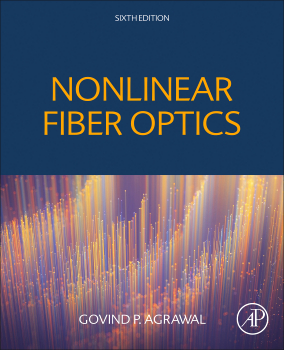
GA: So first of all, let me tell you that until the time I joined Bell Labs, in New Jersey, I had problems publishing papers because my English was not so good. But after I reached Bell Labs, after a few months I wrote an internal report and my American boss there came to me and said, Govind, what you write here is 100 times better than what my American friends write here. None of them can write so clearly. He said “I’m very impressed how you explain these things”. So I was very surprised. I said, “Wow, okay, I mean, I have become a much better writer now, looks like”. So I thought, let’s take advantage of that and I will write a book. I was working with semiconductor lasers at that time. So I thought that the first book I will write will be about semiconductors. I teamed up with a guy called Niloy Dutta who was also there, a Bengali guy. We wrote a book. He was an experimentalist. I was modeling the theory. Together we wrote our first book on semiconductor lasers and this book was published in 1985. At that time I was not working in fibers. Fibers were far from my mind and then one day in 1985, a woman walked into my office and she said “I’m working on optical solitons and I would like to talk to you. Perhaps you can help me”. I asked her “Who sent you here? Because I do not work in this area. I don’t know what solitons are. I have no work with pulses. I only work with beams. I have no idea what you’re talking about!” She said, “it’s okay but let’s just talk”. So I started talking to her, she was telling me about this soliton thing, this and that and she said “I need someone who can develop some code for this, so that we can do both analytical and numerical work on this”. Initially I was very reluctant but then suddenly it hit me that I have written these codes for relaxation of a laser which are basically diffraction of beams but what she’s saying is diffraction or dispersion they’re actually the same thing, so I can just use my existing code. So I agreed to work with her. So she’s the one who really brought me to the fiber optics area. And for a year we worked together, published three papers on solitons and pulse propagation in a fiber. I started learning the language a little bit and here we’re talking about 1985, 1986.
DC: So at that time Erbium doped fibers were already there?
GA: No they were not there yet. So I started learning and then I started seeing all this interesting work being done in Bell Labs at different groups. We started learning about different things. I said maybe I want to write a second book on my own. I can write a book in this area which I’m just learning and that will force me to learn better than I can do otherwise. So I didn’t think that this book would become a popular book. I just thought of writing because I wanted to learn this area and because I want to learn this area I ended up writing in such a way that it is easier for people to follow. So the book was written to teach myself fiber optics. The success of the book was just completely unexpected for me. So in my life a lot of things happened by chance, that’s kind of one theme I find throughout my life. Chance plays a big role in achieving success, but you have to be ready there to catch it.
DC: So according to you what are a few unanswered exciting questions in the field of let’s say nonlinear optics or you can say optics in general that in your opinion might have a very big impact on the future of science and technology.
GA: So when I think about it I can think of two things which could be interesting in the future. One is what people call quantum nonlinear optics right, so to me it’s sort of strange. When you think about quantum, it generally means a single or few photons and on the other hand nonlinear optics always requires high intensities. So to me how can we observe nonlinear effects using very low intensities, is very interesting. So I think this area may develop in the future. I don’t know how much, but it will require some very different materials, probably because after all you need something which has a very high nonlinear coefficient. And the second direction which I think is ultra-intense light-matter interaction. People are going towards very high energy pulses and in that regime you have this breakdown and all those kinds of things. That’s another direction where a lot of new things may happen because electric fields are very huge and atoms are breaking apart. There’s plasma and there is much more to come in the future I think.
DC: Do you think there are few skills which undergraduate physics students should develop for a bright scientific career in the future?
GA: So the one skill which I tell my students as well is to do things early, not wait to finish anything. I mean when I give homeworks to my students in my class they typically ask to give them a week’s time to finish their homework, but they don’t start it the day before the deadline. They’re always running at the last minute to ask for it. So what’s the point of giving a week to do it if you’re always going to work on it on the last day? So it’s sort of very strange to me. My philosophy has always been to do things right away, and I’m known for it in my department. When I get an email and it asks me something and it gives me a deadline I actually do it then and there. So I do things as they come in. So do things in advance, early on, so that you’re never under pressure.Your life will be much much simpler if you don’t wait for the deadline. Most people don’t do that. So that’s one skill.
I can give you a little tangent to tell you about something, that before I moved to Rochester I said if I move to Rochester I should probably know someone there. So I should try to make contact with someone there. And that’s the second advice I wanted to give to students. Don’t be afraid of making connections. So I was saying that I needed to know someone there who can vouch for me, otherwise if nobody knows me how do you get a job? So I thought my grand advisor (advisor’s advisor) Emil Wolf was there. And then I found out that he was actually publishing a book series called Progress in Optics. So I sent a letter to him. I told him I was his academic grandson (student’s student). I would like to propose to write a book chapter. I gave him a deadline. So he consulted and he asked me to write it. I worked on it immediately and sent it to him before the deadline. He sent me a letter saying that nobody in his entire career had ever delivered the chapter on the first deadline. I sent him two weeks before the deadline! He was so impressed he immediately wrote me a letter saying this has never happened. I was surprised. Why not? Because my habit is if I say something I do it in advance. So that struck him and when my application came in, I’m sure he really supported me for that. So second advice in that topic is don’t hesitate in making contact and even senior people who are high up, you may think that they don’t care about you but if you talk to them they will be very nice to you. I was impressed how nice Wolf was to me whenever I talked to him. And third I think communication skills are very important for everyone. So I think the three points you were asking me are basically : do things in time or early, don’t hesitate talking to senior people, and then develop communication skills. Those are very important.
DC: If you could have dinner with any scientist from history, who would it be and why would you choose that person?
GA: Probably everybody thinks of Einstein. But when I think about it the person who comes to my mind is Niels Bohr, and the reason he came to my mind was because he was doing quantum mechanics before quantum mechanics was developed. No one had the tools and he still could quantize the hydrogen atom and tell you what energy levels are. He was using classical physics. He did classical physics and basically based on that he came up with the idea of having the energy state. To me that is amazing.
DC: Do you have any final message for young scientists especially in India?
GA: I guess the message from my life story I told you simply is that failures are always part of the game. You don’t expect to succeed at everything you want to do. Certain things will not work. You have to learn to take the failures without feeling depressed, and still keep doing your part and eventually things will work out. There will always be rough times. Nobody succeeds without a rough time. And luck plays a big part. As I have seen, just being hardworking and being intelligent is not enough. I mean I succeeded but by luck partly, because there’s hundreds of people in India like me who don’t succeed even though they are as good as I am.
DC: So yeah, that was awesome. I really enjoyed discussing all these things with you. Thank you very much for this interview!
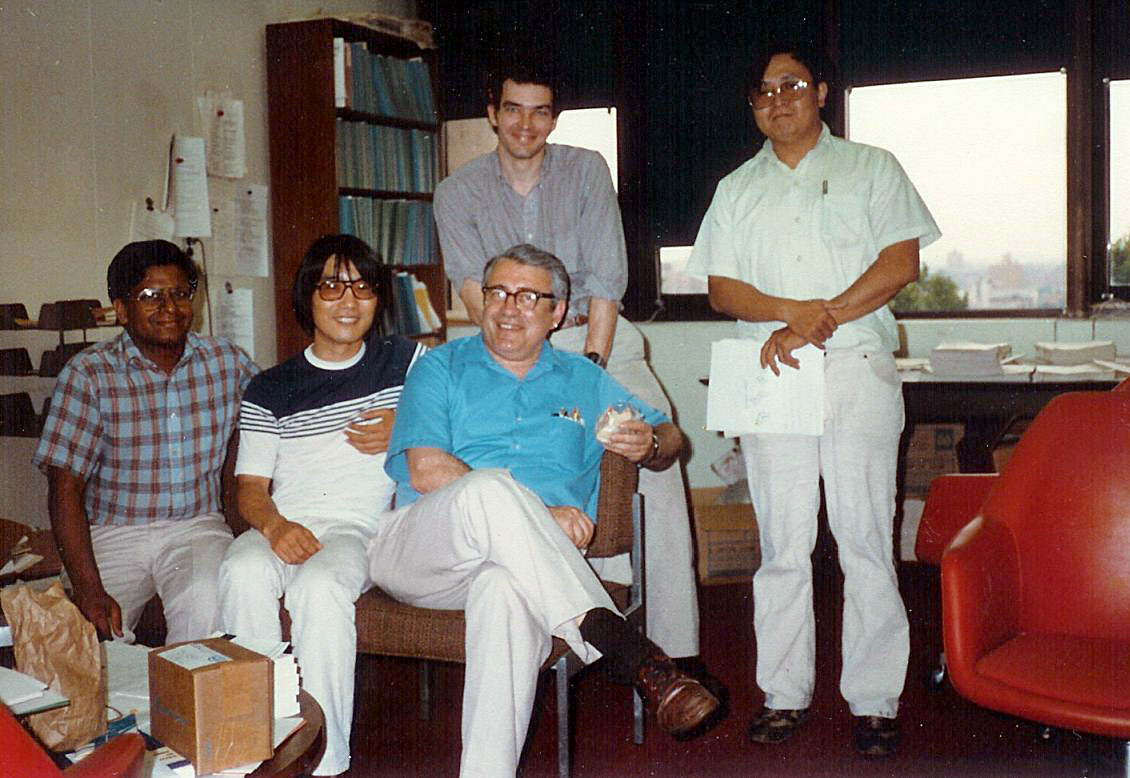
Prof. Melvin Lax (middle), who was a professor at the City University of New York
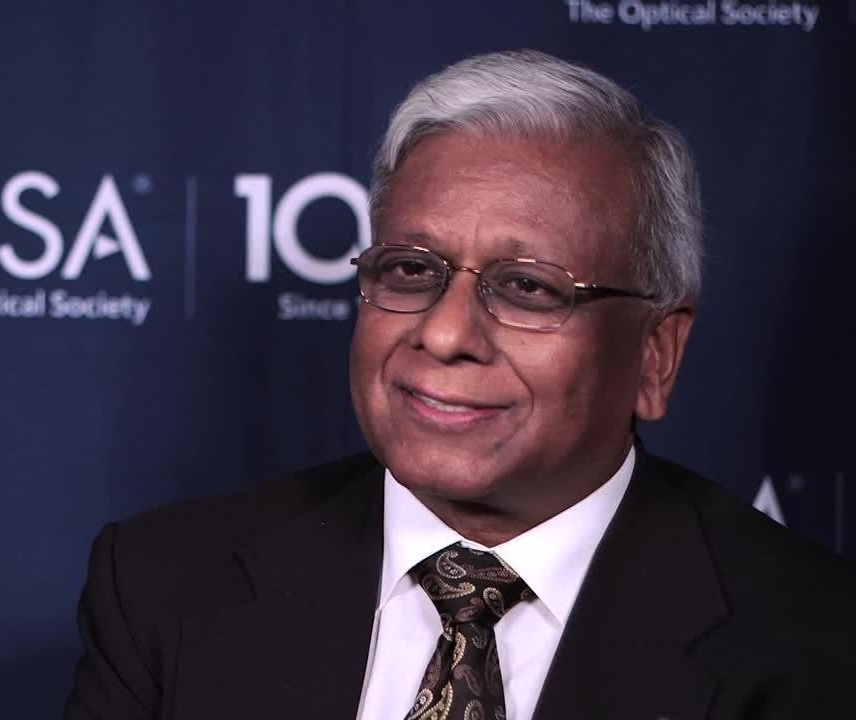
Professor Govind Agrawal is the James C. Wyant professor of Optics at the Institute of Optics, University of Rochester, USA. He is famous for his book Nonlinear Fiber Optics, which is widely accepted as the standard reference in the field, and is cited over 30,000 times. He is also an extremely accomplished researcher in optics and photonics, with more than 500 papers in peer-reviewed scientific journals. He is the recipient of several prestigious awards including the Optica Max Born Award for outstanding contributions in physical optics. Here is an interview with him, conducted by Debanuj Chatterjee.