The Mystery of Galactic Spiral Arms: From the Winding Dilemma to Density Waves
Reviewed by
According to Edwin Hubble’s celebrated tuning-fork classification, galaxies are broadly divided into two principal morphological classes: elliptical galaxies and disc galaxies. In elliptical galaxies, stars are supported against gravitational collapse primarily by their random motions, whereas in disc galaxies they are supported by their ordered rotation about the galactic centre.
The most striking and visually captivating features of many disc galaxies are their spiral arms, which distinguish them from other classes of galaxies. Observations show that these arms rotate approximately as a rigid pattern with a nearly constant angular velocity, known as the pattern speed, even though the individual stars and gas clouds within the disc orbit the galactic centre at different angular speeds.
Spiral Arms and the Secular (Slow) Evolution of Galaxies
Spiral arms are far more than visually striking structures; they play a pivotal role in shaping the long-term evolution of disc galaxies. As non-axisymmetric features in the galactic disc, spiral arms introduce a quadrupole component into the galaxy’s gravitational potential. The resulting gravitational torques redistribute angular momentum between different parts of the disc and the surrounding dark matter halo, thereby driving the galaxy’s secular evolution.
Spiral arms also profoundly influence the distribution of interstellar gas. Through gravitational torques, they induce gas inflow from the outer regions of the galaxy towards its centre, where the accumulated gas can fuel active galactic nuclei and contribute to the growth of the central supermassive black hole.
In addition, spiral arms are overdense regions of the galactic disc. As gas clouds pass through these regions, they are compressed by the enhanced gravitational field, triggering the collapse of molecular clouds and the formation of new stars. Consequently, spiral arms are the principal sites of star formation in disc galaxies.
The Winding Dilemma
Until the early 1960s, the origin and long-term persistence of spiral arms remained one of the greatest unsolved problems in galactic astronomy. Astronomers knew that galaxies exhibit differential rotation, with stars in the inner regions completing an orbit around the galactic centre much faster than those farther out. Consequently, over their lifetimes, most galaxies have completed roughly 20–100 rotations.
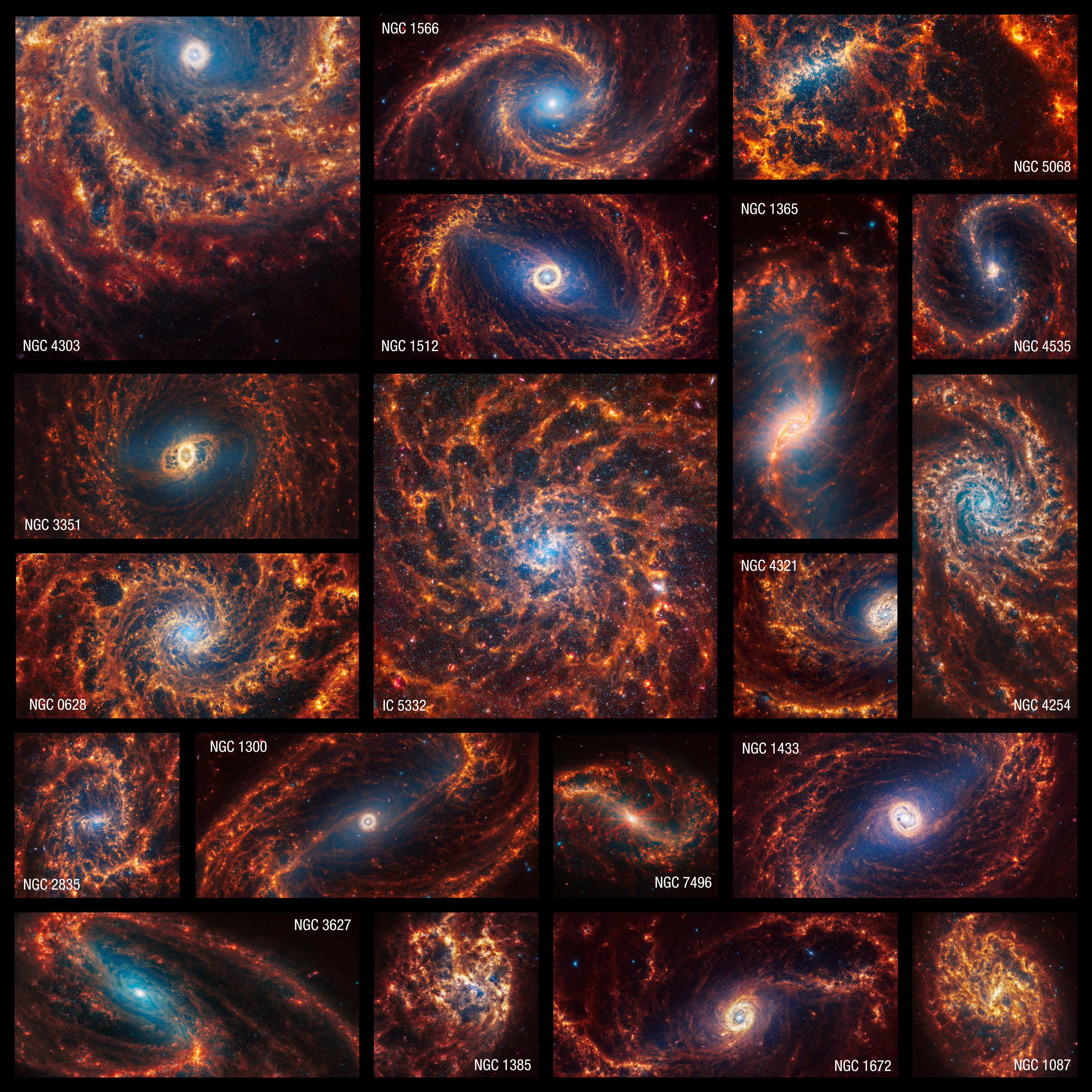
If spiral arms consisted of the same stars and gas clouds throughout their lifetime—that is, if they were material arms—differential rotation would progressively wind them into increasingly tighter spirals. After 20–100 galactic rotations, such arms would have wrapped around the galactic centre many times, producing tightly coiled spiral patterns.
Observations, however, tell a very different story. The spiral arms of most galaxies are wrapped only once or twice around the galactic centre and remain relatively open, even in systems that are billions of years old. This apparent contradiction became known as the winding dilemma.
The winding dilemma led astronomers to an important conclusion. Either spiral arms are transient features that repeatedly form and dissolve on timescales much shorter than the age of a galaxy, or they are not material structures at all. The latter possibility ultimately gave rise to the density-wave theory, according to which spiral arms are long-lived waves of enhanced stellar and gas density rather than permanent collections of the same stars and gas clouds.
Traffic Jams, Density Waves, and Galactic Spiral Arms
How can spiral arms persist for billions of years without being composed of the same stars? An elegant answer is provided by an analogy familiar to anyone who has experienced a traffic jam.
Imagine a slow-moving procession travelling along a highway. As faster-moving vehicles approach the procession, they are forced to slow down, forming a region of congestion. After passing the procession, the vehicles gradually accelerate and resume their normal speed.
Now consider this situation from the perspectives of two observers. The first observer watches from an aeroplane and notices a compact region of high traffic density moving slowly along the highway with the procession. To this observer, the traffic jam appears to be a coherent structure travelling down the road.
The second observer stands beside the highway. This observer notices something quite different. The traffic jam never consists of the same vehicles for very long. Cars continually enter the congested region from behind, remain there briefly while moving slowly, and then leave it after accelerating. The vehicles are constantly replaced by others, even though the traffic jam itself persists.
A traffic jam is therefore not a collection of specific vehicles; rather, it is a wave of enhanced vehicle density propagating through the traffic. In other words, it is a density wave.
Galactic spiral arms behave in much the same way. They are not composed of a permanent set of stars and gas clouds. Instead, stars and interstellar gas continuously move into a spiral arm, slow down temporarily as they descend into the enhanced gravitational potential associated with the overdense region, and later accelerate as they climb out of the potential well. They then continue their orbital motion around the galactic centre until they encounter the spiral pattern again.
Thus, the stars themselves are continually moving through the spiral arms, while the spiral pattern persists as a long-lived region of enhanced stellar and gaseous density. At any given time, the spiral arm contains different stars and gas clouds than it did earlier.
An important feature common to both traffic jams and spiral arms is that the wave propagates independently of the individual constituents of the medium. Cars move through a traffic jam; stars move through a spiral arm. The pattern and the particles therefore have distinct motions.
Another remarkable consequence of this picture is that the wave can survive even after the disturbance that originally generated it has disappeared. A traffic jam may persist long after the procession has left the highway because the disturbance continues to propagate through the flow of vehicles. Likewise, a spiral density wave can continue to exist long after the perturbing influence that excited it has vanished.
This simple traffic-jam analogy captures the central idea of the density-wave theory: spiral arms are not material structures but long-lived waves of enhanced density through which stars and gas continually pass.
Density Waves as Normal Modes of Oscillation
The central idea behind the density-wave theory is that spiral arms represent normal modes of oscillation of the galactic disc, much like the standing-wave patterns observed on a vibrating string or the normal modes of a drumhead.
The theory seeks a self-consistent perturbation of the disc’s surface density that can propagate through the galaxy without continuously winding up under differential rotation. In such a mode, the enhanced density of stars and gas generates a perturbation in the galaxy’s gravitational potential. This perturbed gravitational field, in turn, induces stellar motions that reproduce and sustain the same density enhancement. In other words, the density perturbation and the gravitational potential perturbation reinforce one another in a self-consistent manner.
This mutual reinforcement is the hallmark of a normal mode. The gravitational field produced by the perturbed mass distribution is precisely the field required to maintain the stellar motions that created the perturbation in the first place. As a result, the spiral pattern behaves as a coherent, self-sustaining wave rather than rapidly dispersing under differential rotation.
From a mathematical standpoint, the problem therefore reduces to finding eigenfunctions and eigenfrequencies of the galactic disc that satisfy the equations governing the coupled dynamics of stars and their self-gravitational field. Each eigenmode corresponds to a possible global spiral pattern with a well-defined pattern speed. The grand-design spiral arms observed in many galaxies are believed to correspond to one or more of these global normal modes.
Energy Exchange Between Spiral Waves and Disc Stars
Because galactic discs undergo differential rotation, spiral density waves continually exchange angular momentum and energy with the stars in the disc. This interaction is not uniform throughout the galaxy; instead, it occurs most efficiently at special locations known as Lindblad resonances.
A star moving around the galactic centre periodically encounters the crests and troughs of the spiral gravitational potential. Most of the time, these encounters are out of phase and the gravitational perturbations largely average out over successive orbits. At the Lindblad resonances, however, the situation changes dramatically. Here, the frequency at which a star encounters the spiral pattern either matches the star’s natural epicyclic oscillation frequency or, in the limiting case of corotation, becomes zero, so that the star remains nearly in phase with the spiral potential. Under these resonant conditions, the cumulative gravitational interaction becomes much more efficient, leading to a substantial exchange of angular momentum and energy between the stars and the spiral wave.
The Inner Lindblad Resonance (ILR) generally acts as a sink for spiral waves. As the wave transfers energy and angular momentum to the stellar disc, its amplitude decreases, causing the wave to be damped. By contrast, near the Outer Lindblad Resonance (OLR), the wave propagation changes character, and under suitable conditions the wave may be reflected back towards the inner regions of the galaxy. These resonant interactions therefore play a crucial role in determining both the propagation and the longevity of spiral density waves.
The existence of these resonances is central to modern theories of spiral structure. They govern how spiral waves transport angular momentum across the galactic disc and determine whether a spiral pattern is amplified, damped, or reflected. Consequently, the long-term evolution of spiral galaxies is intimately linked to the dynamics of these resonant wave–matter interactions.
Standing Spiral Waves and the Q-Barrier
If an inward-propagating spiral density wave reaches the Inner Lindblad Resonance (ILR), it transfers its energy and angular momentum to the stellar disc and is consequently damped. In this case, the spiral pattern gradually loses its strength and cannot survive for long times.
A much more interesting situation arises if the wave is reflected before reaching the ILR. Under these circumstances, the reflected wave can interfere with the outgoing wave to form a quasi-stationary standing wave in the radial direction. Such a standing-wave pattern can persist over many galactic rotations and provides a natural explanation for the longevity of grand-design spiral arms.
The reflection occurs because certain regions of the galactic disc inhibit the propagation of spiral density waves. These regions, commonly referred to as Q-barriers, arise where the local dynamical properties of the disc—particularly the stability parameter (Q)—prevent the wave from propagating further. Instead of penetrating these forbidden regions, the wave is reflected, much like a light wave reflected from a boundary between two media.
The repeated propagation and reflection of spiral waves between the Q-barrier and the outer disc can establish self-consistent global standing-wave patterns, often referred to as spiral wave modes. These global modes constitute one of the central ideas of the density-wave theory, explaining how spiral structure can remain coherent for timescales far longer than would be possible for material arms.
Identifying new spirals from astronomical data sets using Machine Learning
Spiral galaxies are broadly classified into grand-design and flocculent systems based on the morphology of their spiral arms. Grand-design spirals exhibit prominent, continuous, high-contrast spiral arms and are generally associated with large-scale, quasi-stationary density waves. In contrast, flocculent spirals display fragmented, patchy, and low-contrast spiral features that are thought to arise primarily from local gravitational instabilities and stochastic star formation.
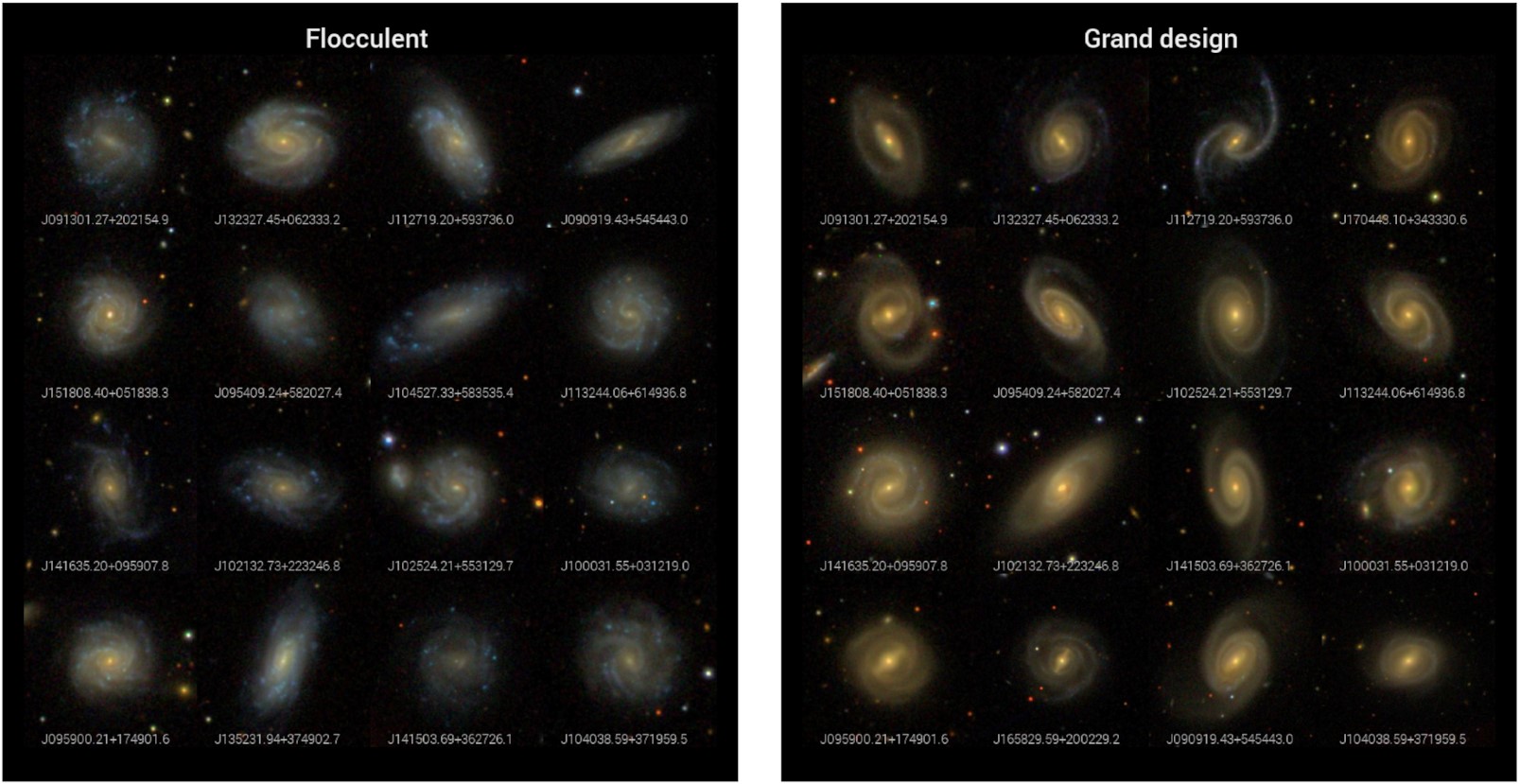
We develop a deep convolutional neural network (CNN) to automatically classify spiral galaxies into these two morphological classes. The trained network is subsequently applied to classify a sample of 1,354 spiral galaxies from the Sloan Digital Sky Survey (SDSS). Of these, 721 are identified as flocculent galaxies and the remaining 633 as grand-design spirals.

Dr. Arunima Banerjee is a theoretical astrophysicist, specializing in the dynamics of galaxies and the application of machine learning in galactic astronomy. She is currently an Associate Professor and the Chair at the Department of Physics, at the Indian Institute of Science Education and Research Tirupati, and a Visiting Associate of IUCAA, Pune. She is also an Editorial Board Member of the Journal of Astronomy & Astrophysics of the Indian Academy of Sciences. Music, painting, and reading are her favorite pastimes.
References
- Combes, Boisse, Mazure & Blanchard, Galaxies & Cosmology, Springer
- Elmegreen, Galaxies & Galactic Structure, Prentice Hall
- Bertin, Dynamics of Galaxies, Cambridge University Press
- Fridman & Polyachenko, Physics of Gravitating Systems II, Springer-Verlag
- Sarkar, S., Narayanan, G., Banerjee, A., Prakash, P., 'Identification of Grand-design and Flocculent spirals from SDSS using deep convolutional neural network', Monthly Notices of the Royal Astronomical Society, Volume 518, Issue 1, January 2023, Pages 1022–1040, https://doi.org/10.1093/mnras/stac3096