Insight Digest | Issue #10
In Insight Digest, we showcase the latest happenings in science research.Seeing entanglement in a cuprate spin chain
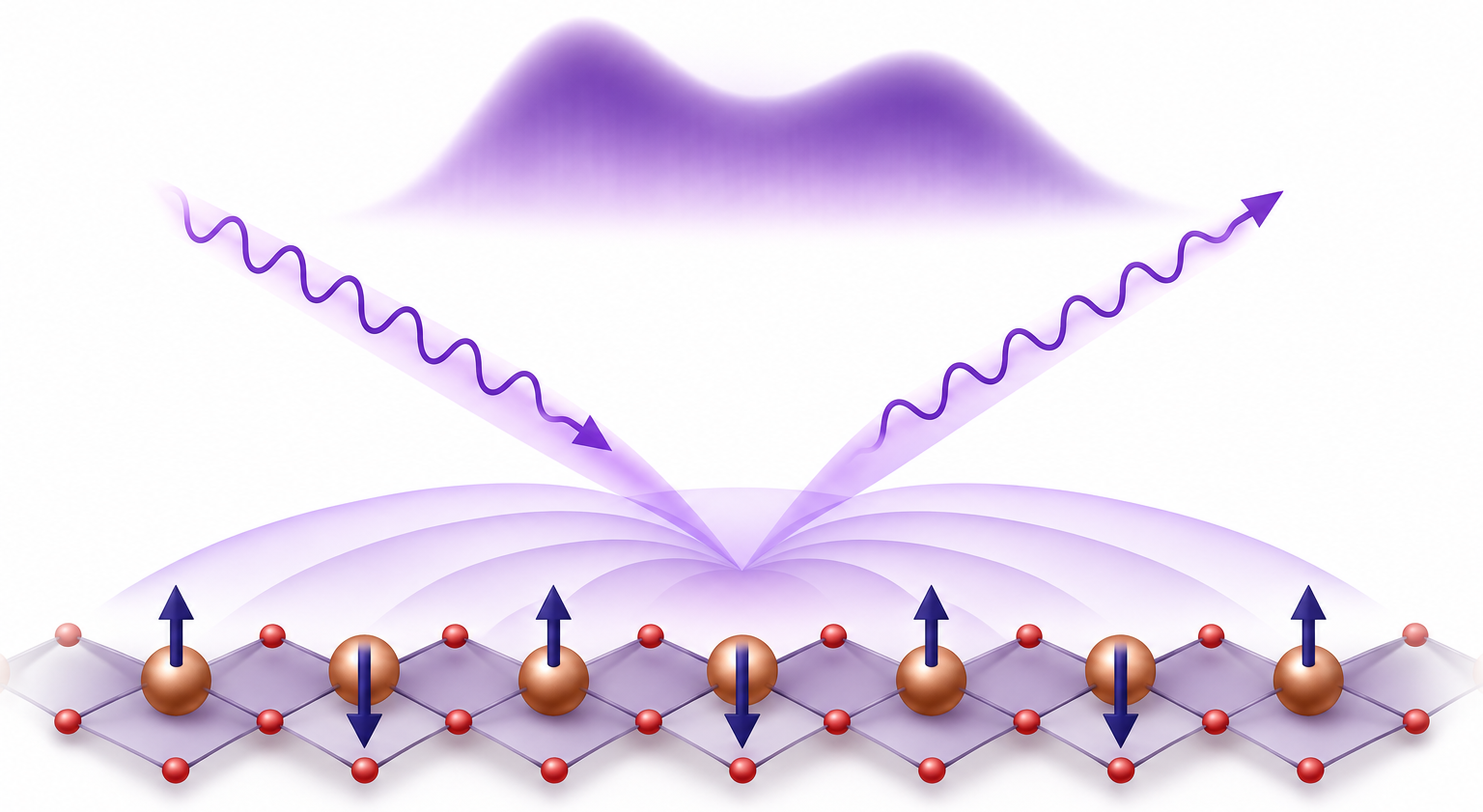
S. F. R. TenHuisen et al., arXiv:2609.08134, Sept. 08, 2026 (Department of Physics & Astronomy, Seoul National University) Subjects: strong-correlations, entanglement, materials-science Entanglement is one of the distinguishing features of quantum mechanics and a core aspect of modern quantum condensed matter physics. Many of the interesting phenomena seen in the so called quantum materials bear their origin to intricate patterns of entanglement between the consituent particles. Yet, it is difficult to quantify entanglement measures in the laboratory: reconstructing a many-body quantum state requires measuring an exponentially large number of observables because of the exponential growth of the Hilbert space seen in systems of interacting particles. In this work, TenHuisen and colleagues ask whether resonant inelastic X-ray scattering (RIXS), a widely used probe of excitations in correlated materials, can instead witness entanglement through what's called an entanglement witness. Entanglement witnesses are quantities that are not as powerful as entanglement measures – they can detect whether a state has entanglement but cannot quantify the amount of entanglement. But their main advantage is that they can be experimentally measured. For example, in this work, the authors probe the **quantum Fisher information** (QFI) – an entanglement witness that can be linked to a dynamical spin structure factor. The spin structure factor roughly quantifies how likely it is that a system will be excited by a specific energy through a specific spin-flip process.
Their test case is Sr2CuO3, an insulator with strong magnetic interactions. It turns out that its low-energy state is quantum critical, which essentially means that the correlations within it span long distances. The low-energy excitations fractionalize into spinons, which means its quantum numbers are fractional. These long-range quantum fluctuations make the chain a promising place to find deep spin entanglement—and a well-characterized setting in which to test a new measurement protocol.
As mentioned, the authors use QFI to probe the system. For a spin-\(\frac{1}{2}\) system, the QFI per spin above a value \(m\) certifies entanglement involving at least \(m + 1\) spins. The challenge is that RIXS intensity is not simply the spin structure factor: in an interacting many-body system, other processes always contribute. The work calculates the appropriate spin structure factor by combining the experimental data with theoretical calculations of relevant models using exact diagonalisation and density matrix renormalisation group (DMRG). At 35 K, the momentum-resolved QFI peaks at a value exceeding six, witnessing at least seven-partite spin entanglement. At 220 K, the witness remains above four near specific directions in momentum space, still certifying entanglement among at least five spins. The result shows that substantial multipartite correlations survive well above the lowest measurement temperature, because the chain’s large exchange scale keeps it in the quantum regime.
This is a first demonstration of RIXS as a probe of multipartite spin entanglement in a solid. The inference depends on a material- and geometry-specific, theory-assisted mapping from RIXS intensity to the spin response, so it is not yet a model-free measure. Even so, the method opens a path toward testing entanglement in less tractable materials.