Z is for Zeta
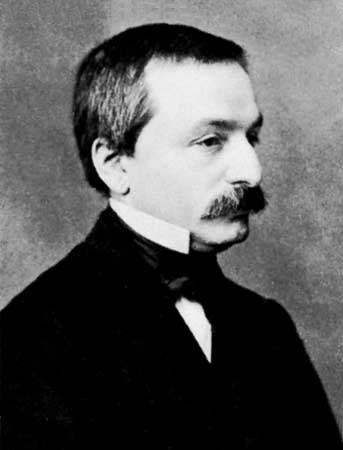
Leopold Kronecker is famously known for his quote,
God created natural numbers: all else is the work of man
Right from the usual counting that we do on a daily basis, the set of natural numbers - given a nice notation by mathematicians, is ubiquitous in daily life. One rather mysterious and highly misunderstood notion regarding the set of natural numbers is the statement
The buzz around this “identity” has been exemplified in math popular culture due to the scores of online content - some of which unfortunately serve as clickbait without conveying the whole mathematical idea properly. This article is an attempt to dispel some of the myths around this so-called mysterious “identity” and see whether this statement is true. This article shall take a mathematical perspective and hence shall not address things related to this concept in physics or any other world other than math. The beauty of mathematics lies in unlocking these “mysteries” through rigor and logic - a trait that makes math the Queen of all sciences. In fact, a thorough mathematical understanding of these concepts actually helps in concluding that there is no mystery here but just the sheer beauty of math.
If one were to see the expression , the first thing that probably crosses their mind is possibly that, how can the “sum” of positive numbers be a negative number? But hang on, the first question should be, How does one find the sum of infinitely many terms, ain’t it? A more interesting question is whether such a number as the sum of the given infinitely many numbers even exists. Here is where the mathematical formulation of a series comes in. An illustrative example to explain the notion of convergence or sum of what we call an infinite series (a category to which the sum in question - namely belongs) was given in [1]. We revisit that example here, but before that let’s shed some light on sequences, which are, in some sense, the building blocks of series.
A sequence of real (resp. complex) numbers is a function from to (resp. ), that is, to each natural number there is a unique real (resp. complex) number associated. In short, we can represent a sequence by , which means is mapped to . Given a sequence, an interesting question is whether we can associate one single number that depicts the behaviour of the whole sequence. Let us consider the sequence . Since all the terms in the sequence are , it makes sense to designate as that number which depicts this sequence. Ok, this was easy! What if the sequence is given by
Now it looks like a good candidate for the number we are looking for is . This is nothing particular to this case - where every term except the first three terms are identical. In fact if we define the sequence for all and for all then too, it makes sense to take as the candidate as “more and more” terms of the sequence take the value .
Source: [10]
Now what if there is no repetition of terms? Can we find a candidate number to represent the sequence? On that note, let us look at the sequence
The terms in the sequence are . Now, there is no term that is repeating, and it looks like there is no end in sight in terms of repetitions. But it does look like the terms eventually go closer and closer to . How do we make sense of it? If you had observed in the above examples, it turns out that, in defining our candidate number, all that mattered was a section of the sequence that lay beyond a specific . We call this the tail of the sequence. So, does it mean that for any given sequence we can associate a candidate to represent it? It turns out that the answer is, no! Let us look at the sequence . This sequence is (i.e.) and appear alternatively. It is clear that we can’t get a proper “tail” in sight as beyond any given , both and keep occurring alternatively.
We call a number to be the limit (the candidate number that we were talking about in the examples) of the sequence , no matter how “close” we get to , we can find a tail of the sequence that lies in that proximity. Such sequences are called convergent sequences and by we mean that converges to (i.e.) the limit of the sequence is . We list a few properties of convergent sequences.
-
Suppose and , then . (sum of two convergent sequences converges)
-
Let and , then (multiplying the terms of a convergent sequence by a scalar does not affect the convergence of a sequence and in fact the limit of the resultant sequence is scaled by the appropriate scalar)
-
Its a non-trivial and interesting result that if then the sequence
converges to . (the sequence of averages upto terms of a convergent sequence converges to the same limit as that of the original sequence)
We now try to explore infinite sums and see if we can assign particular values to them. We shall try to explore a few summation “techniques” on the way and try to compare the different “definitions”.
A series is typically an infinite sum where each is a real or complex number. Now, how do we make sense of this sum? Can we associate a limit for a series and call it the value of this infinite sum? To achieve this, we use the help of sequences. At the moment even as we don’t know a proper way to find the sum of an infinite series, we do know how to add finitely many terms. We use that knowledge to define sum of the series and find that it has all the nice properties. We now view the above series as a sequence in which each term is actually a sum of finitely many terms. More precisely, the first term is just one number, , second term is a sum of the first two numbers, , third is a sum of three numbers, and so on. We can represent the term of this sequence by and this is called the - partial sum.
D1: We define the sum of the series to be the limit of the sequence (if it exists).
A series for which this limit exists is called convergent, and one for which it does not exist is called a divergent series. This definition gives all the nice properties to series. For example, using this definition, it follows that the sum of two convergent series is convergent, and its limit is the sum of the individual limits. In fact, this conclusion is a corollary of a similar result on sequences, and it follows from the properties of convergent sequences given above. With some effort, it can be observed that this definition efficiently facilitates the addition of two convergent series, multiplying elements of a convergent series by a scalar, removing and adding finitely many terms to a convergent series and still not altering the sum of the series. It also clearly distinguishes when the rearranging of terms is possible in a series and also takes into account different ways of grouping terms while adding and thus minimizes ambiguity, thereby ending up with a unique value of the sum of an infinite series, provided it exists.
One of the basic examples of a convergent series is the geometric series where . Another good class of examples of convergent series is where . While we saw that the sequence converges, with a little effort, it can be shown that the series does not converge. From the definition, it is straightforward to see that is not convergent as the sequence of partial sums diverges. There are various tests to determine the convergence of a series of positive terms and ones with terms having terms whose sign alternate - which we call an alternating series. One example is and it can be shown using one of the above-mentioned tests that this series converges. Speaking of alternating series, it is time to revisit our example from [1], namely . Clearly, by definition, this series diverges as the sequence of partial sums does not converge.
This example leads us to see if we make this series converge in a different world. A natural question that might arise in this regard is the need to do this in the first place. We know that our definition classifies this series as divergent, so why bother much? It turns out that having a notion of “limit” for certain divergent series helps in some branches of mathematics - one example of which is Fejer’s theorem in Fourier analysis. Another argument in favour of trying to do this is related to the property (3) that we saw above for convergent sequences. We have seen that any convergent series follows that property, but the converse is not true. Thus, it makes sense to have a universe where we can try to see if the converse is true. While we will not go into it in more detail, it is worth mentioning that a few results exist in this direction. We will generalise our definition of sum of a series by using property (3) to give the notion of limit to a few more series which missed out on this benefit using the previous definition. But when we do this, we should make sure that the series that are already convergent using the previous definition shall continue to converge to the same limit using the new definition as well - which is exactly why we use a property (3) to give the new definition of the limit of a series.
D2: Suppose is a series whose sequence of partial sums is denoted by . Define the sequence . We say is the limit of the series , if the sequence converges to .
So far, we have seen two different notions of the limit of a series. The previous definition, marked as D1 denotes Definition 1 and the above notation D2 denotes Definition 2. Suppose a series converges using D1, it clearly converges using D2 as well - by simply using the property (3) for its sequence of partial sums. Also, note that the series does not converge using D1, but it converges using D2. This is because the sequence in this case is can be shown to converge to . Many such alternating series that diverge using D1 can be given a limit using this technique. D2 is called the Cesaro summation method. Many other summation techniques exist and are studied in the context of divergent series.
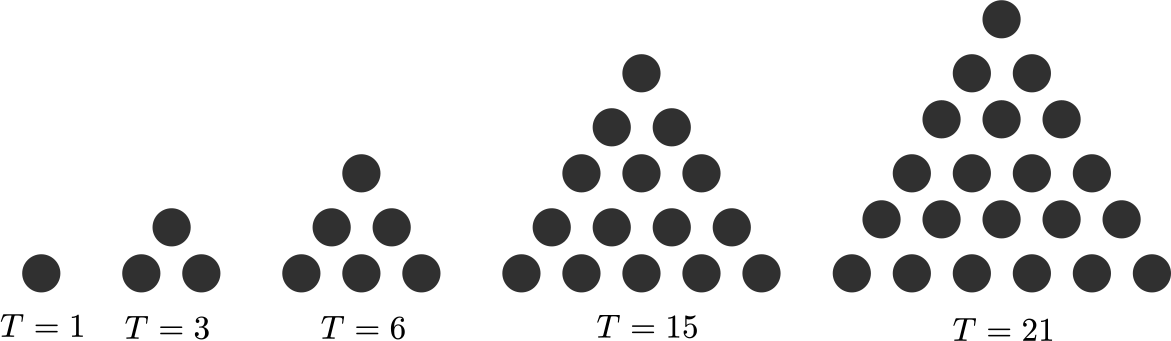
Now, let us look at how the series fares under our definitions. Clearly, it does not converge under D1 because the sequence of partial sums does not converge. As a side note, we hope that an avid reader would have noted that the sequence of partial sums is actually the sequence of triangular numbers (i.e.) the sequence . Also observe that this series does not converge under D2 as well since the sequence in our case turns out to be , which also diverges. In fact, this definition has been manipulated in multiple places on the internet without rigorous explanation to “prove” that the series has limit - which is actually false according to our mathematical setup. One of those online resources actually came from a highly popular YouTube channel. The interested reader may check out [6].
The following arguments are put forward keeping in mind the set up we have developed in this article. One big fallacy in the above-mentioned video is this. They add in two different ways namely and and say that we get limits and respectively - which “clearly” gives the limit to be . Firstly to start with, how did we know that the series has a limit? What definition was used? How can the grouping of terms be justified? Another popular “explanation” for the limit of the series being is that we can take , which gives . But hang on! How do we know that such an exists? This cannot be assumed. This explains the importance of a rigorous definition. While there’s no stopping anyone from defining their own notion of convergence such that their definition allows for the limit of the series to be , the rigors of mathematics do not give us the illogical luxury of beginning with a belief that such a limit exists in the first place. There is a fine line between these two things. As an aside, it is worth mentioning that the video [6] invited sharp reactions from various math communities online, one of them being a nice mathematical exposition, which can be seen in [7].
While we have seen summation methods and have observed that our protagonist does not converge, it makes sense to ask how an unlikely constant like began to be associated with the above series. This is where we go on to the next stage of our exposition. For those who were wondering when the titular character of the article will appear in the article, here is the answer. Well, after hundreds of words into the article, it’s time to unveil the special entity who was waiting to be revealed right from the beginning. Enter the Riemann Zeta function - which is popularly known for its association with the million-dollar open problem of the Riemann hypothesis. So, what does it have to do with ? Well, the Riemann zeta function is a function which gives a series as an output for a complex number that is given as input. It is defined as
Guess what! Putting gives the series
which is precisely our protagonist series. But the only catch here is that converges (this convergence is viewed using D1) for complex numbers with real part greater than . Thus, substituting and “evaluating the value” of the series at this point does not make sense mathematically. So, what can we try to do further?
For a “nice” function like , it would be great to have it defined for all complex numbers. In what follows, we shall actually try to extend its definition to the whole of . Now, does this idea ring a bell? Let us consider the function
Clearly, this function is not defined at but is well-defined and is continuous at all other points. Thus, it would be nice to make it continuous on all of . Why should alone be deprived of the nice property of continuity? It can be justified by using definitions of limits and continuity that this can be achieved by defining . Here comes the subtle but important difference that needs to be noted. We have defined that the function takes the value at the point and not that the value of is at . This is the process of making a discontinuous function continuous by removing the discontinuity at a point. With regards to the zeta function, we do something similar to extend its definition to the whole of . The method by which it is done is called an analytic continuation, which in some sense is slightly analogous (only in principle, but not in technique) to the motivation for the removal of a discontinuity given above.
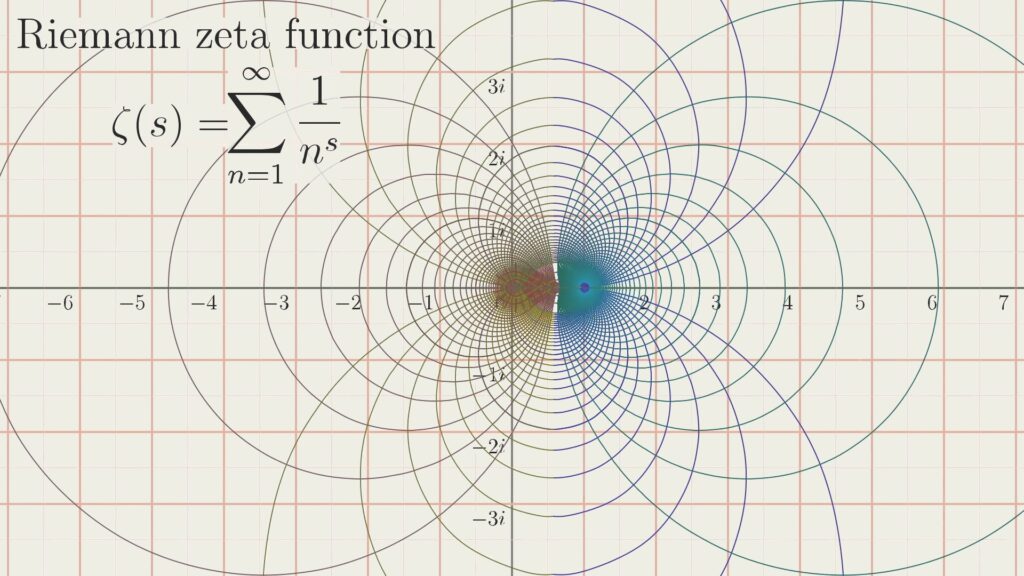
Image Source:[12], which in turn was from a content courtesy 3Blue1Brown.
While differentiability is an important characteristic of functions on , when we move on to , there is a general notion called analyticity (which, in fact, can be spoken about in the case of too), which encompasses the notion of differentiability too. From a naive standpoint, analytic functions on are functions that are differentiable infinitely many times. Typical examples of such functions are polynomials. However, the most important feature of an analytic function is the ability of it to be represented as a special kind of series called “power series” in the appropriate domain. The Riemann zeta function is analytic for all with real part greater than and the series fails to converge for all other , and hence we can’t speak of its analyticity there. So, we now try to extend the definition of for all other values. It should also be noted that the point behaves a bit differently even after extension. This is a highly non-trivial result and involves various mathematical concepts. It involves the well-known gamma function - which again can be considered as an extension of the notion of factorial to complex numbers. The above-mentioned analytic continuation of is achieved by what is called the functional equation of . It can be proved that for , it follows that
Here if real part of is greater than . Otherwise, the gamma function has its own analytic continuation, which is defined using for . Now by substituting in the equation above, we get
The famous Basel problem solved by Euler (which is yet another non-trivial result) tells us that while and . By using all these values, we end up with . This magic number doesn’t come out of nowhere, and this is the proper reasoning behind the phenomenon.
The moral of the story is that and that is not equal to . Unfortunately, the wrong idea that substituting in “gives” the series is associated with most of the clickbait contents on the internet that claim the value of this sum is . But as we just saw, this substitution itself is not possible as the series does not converge at . The key takeaway is that, is not equal to , but courtesy the analytic continuation of the function , gets assigned the value . It is analogous to the situation that we started with. The series does not converge using the usual definition (D1) of a limit of a series, however it gets assigned the value via definition D2. So it all depends on what universe we are working in and what definitions we have in our hands. As long as one can construct a theory and prove results that are consistent with the rules of the game that hold in the universe they’re working in, it does not have any flaws. However, the perspective has to be conveyed clearly without creating any unnecessary confusion. Since the main aim of this article was to convey the whole picture of this misunderstood concept in an expository manner, we did not spend much time on a lot of details and verifications. The interested reader can go through the following resources to get a taste of them. For sequences and series - any first-course text in real analysis, for example, [8] should work. The details on the analytic continuation of the zeta function can be found in an Analytic number theory textbook, such as , [9].
We conclude this article with a short note on zeta functions, for those who are interested in further exploration. The idea of Riemann zeta function has now been extended to various branches of mathematics - ranging from dynamical systems, geometry and group theory. The main principle behind zeta functions is that they serve as a type of generating function to count something interesting. In the case of number theory the Riemann zeta function is found to be connected to the prime counting function - which counts the number of prime numbers that are less than or equal to a given real number. Further generalisation of the zeta function are found within number theory as well. Dynamicists have studied zeta functions related to counting the number of orbits (of the function that they iterate) of period less than or equal to a given real number. Whatever be the avatar in which the zeta function appears, its analytic properties - especially the region of analyticity and the notion of convergence, etc., remain the main focal points that drive the theory in that setting. In fact, one could write a separate exposition on each of the above concepts - but that is a topic for another day!

Bharath Krishna S is an Integrated PhD student from IISER Thiruvananthapuram working in Complex dynamics and Ergodic theory. Apart from his research, he is interested in studying the history of mathematics and writes expository math content where he simplifies concepts from higher math for a general audience.
References
- B. K. S, “Set of Indian Mathematicians Ramanujan Part 2: Balancing research and teaching: The Ananda Rau way,” Exhibit A, 2023, [Online]. Available: https://drive.google.com/file/d/1C9oSunmgXPyea7l42sjaBlxPd5ETJTgO/view
- G. H. Hardy, Divergent series, vol. 334. American Mathematical Society, 2024.
- B. Shawyer and B. Watson, Borel’s methods of summability: theory and applications. Oxford University Press, 1994.
- Mathematics StackExchange, “What are some physical, geometric, or otherwise useful interpretations of divergent series?” [Online]. Available: https://math.stackexchange.com/questions/555083/what-are-some-physical-geometric-or-otherwise-useful-interpretations-of-diverg
- Wikipedia, “Cesàro summation.” [Online]. Available: https://en.wikipedia.org/wiki/Ces%C3%A0ro_summation
- Numberphile, “ASTOUNDING: 1 + 2 + 3 + 4 + 5 + ... = -1/12.” [Online]. Available: https://www.youtube.com/watch?v=w-I6XTVZXww
- Mathologer, “Numberphile v. Math: the truth about 1+2+3+...=-1/12.” [Online]. Available: https://www.youtube.com/watch?v=YuIIjLr6vUA
- W. Rudin and Others, Principles of mathematical analysis, vol. 3. McGraw-hill New York, 1964.
- M. R. Murty, Problems in analytic number theory, vol. 206. in Graduate Texts in Mathematics, vol. 206. Springer-Verlag, New York, 2001, p. xvi+452. doi: 10.1007/978-1-4757-3441-6.
- Wikipedia, “Leopold Kronecker.” [Online]. Available: https://upload.wikimedia.org/wikipedia/commons/c/cc/Leopold_Kronecker_1865.jpg
- Wikipedia, “Triangular number.” [Online]. Available: https://upload.wikimedia.org/wikipedia/commons/thumb/1/1c/First_six_triangular_numbers.svg/1200px-First_six_triangular_numbers.svg.png
- Bhavana Mathematics Magazine, “Special values of zeta functions.” [Online]. Available: https://bhavana.org.in/special-values-of-zeta-functions/
- B. K. S, “Z is for Zeta,” Exhibit A, 2024, [Online]. Available: https://drive.google.com/file/d/1DZ_H3lpg6eRXh9_5IT50uHr7l3BKazuG/view
- 3Blue1Brown. But what is the Riemann zeta function? Visualizing analytic continuation. url: https://www.youtube.com/watch?v=sD0NjbwqlYw.